

Behind the Image: Pivoting for Perfect Light in the Moab Backcountry
When Plan A fizzles, you pivot. Discover how a quick change of plans and a brewing desert storm turned a failed sunset shoot into a dramatic, fleeting photograph of one of Moab's hidden backcountry hoodoos.
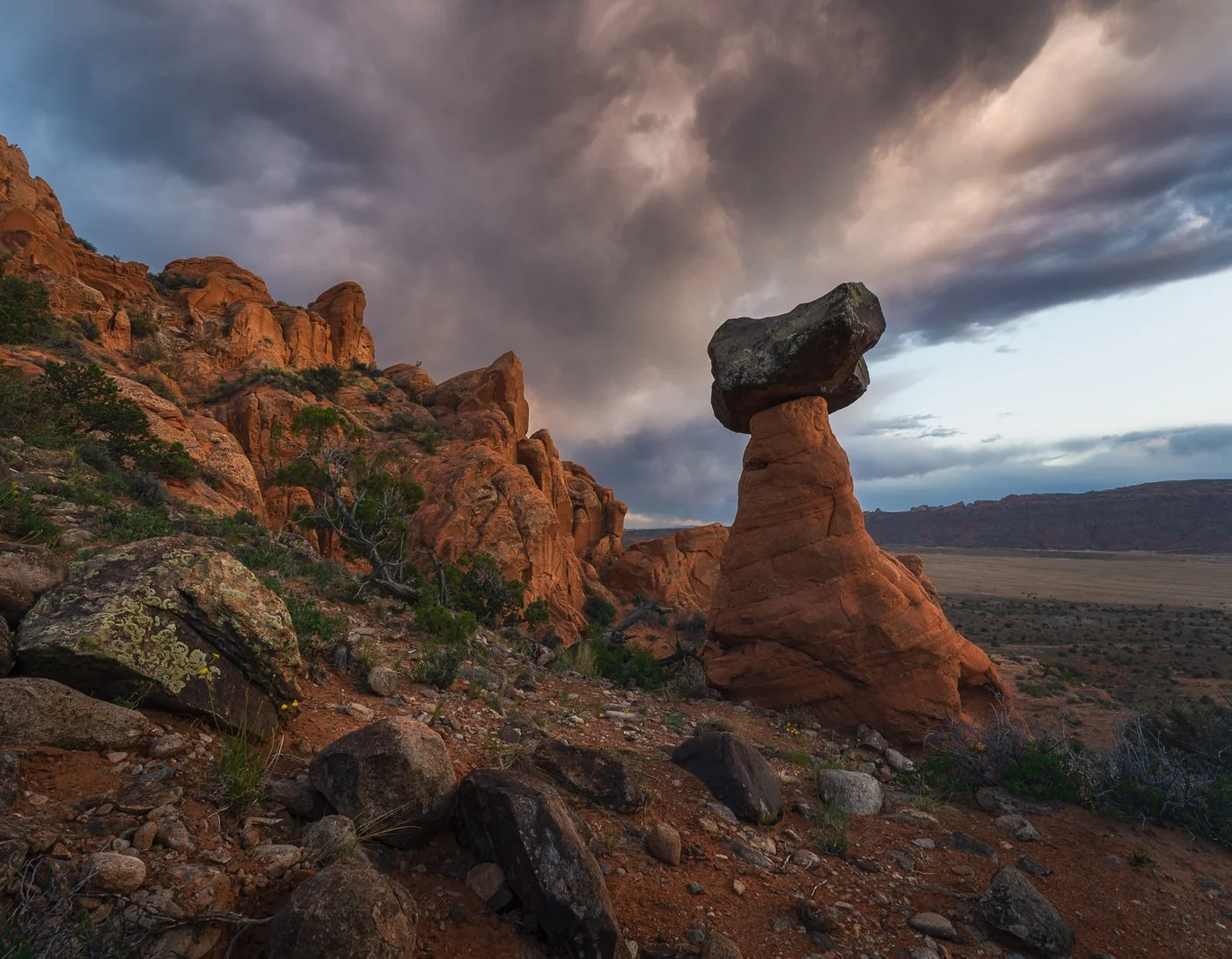
A towering red rock hoodoo stands precariously on a rugged hillside under a dramatic, cloud-filled sunset sky in the Moab desert.
Every landscape photographer knows the feeling: you notice that conditions look promising for an epic sunset so you skip dinner, and drive to a location you’ve had in your back pocket for a day just like this. You arrive and shoulder your pack with high hopes for a spectacular sunset only to be disappointed when the conditions that brought you out just sort of…fizzle. Nature doesn't always play by our rules.
Just last weekend in the Moab backcountry, I found myself in exactly that situation. I had positioned myself at a waterfall with a commanding view of sandstone spires, waiting for the light to strike. Unfortunately, the dark clouds that had gathered in the sky above the scene drifted out of the frame toward the west just before the light was about to explode onto the scene. It quickly became clear that "Plan A" was a bust.
Instead of calling it a day, I decided to pivot.
I hurriedly packed up my gear and headed to a nearby alternative: a striking, gravity-defying sandstone hoodoo I’d discovered a few years prior and had recently shot multiple times. As I arrived, the conditions shifted drastically. A powerful storm was rolling through, and the dramatic, brooding clouds began to catch the final, fleeting moments of the evening’s golden light.
I named the final photograph A Fragile Balance.
Here is the story behind how this image came together, and how pre-visualization and location scouting saved the day.
The Importance of Having a Photographic "Plan B"
When you are shooting landscape photography in Moab, flexibility is your greatest asset. The desert weather can change in a matter of minutes—especially when a storm is brewing.
Because I have spent years exploring and guiding clients throughout the Moab area, I already knew this hoodoo intimately. I had scouted it, photographed it in different seasons, light and conditions. I knew its exact orientation to the setting sun.
When my first location failed, I didn't waste precious time figuring out where to go or what to do next. I knew this hoodoo was just minutes away and that it would perfectly capture the dramatic mood of the developing storm sky.
Composition and Pre-Visualization: Beating the Clock
By the time I scrambled up the rocky red slope to the hoodoo, I knew I only had a few minutes—maybe less—before the best of the light vanished.
This is where pre-visualization and advanced preparation pay off. Because I had shot this location before, there was no guesswork involved:
Lens Selection: I knew I’d be using my Sigma 14-24mm wide-angle lens to capture the towering scale of the hoodoo while simultaneously keeping the rugged background cliffs and sweeping storm clouds in the frame.
Composition: I positioned myself low among the foreground boulders, using the natural slope of the ridge to lead the viewer’s eye up toward the balancing rock. This angle emphasizes the "fragile balance" of the massive boulder perched precariously atop its sandstone pedestal.
Managing the Light: I had to work quickly to balance the warm, golden glow striking the red rock with the deep, moody blues and purples of the storm clouds above. I underexposed by two stops to retain highlight detail, knowing I’d be able to bring up the shadows in Lightroom without introducing any noise.
I had just enough time to lock down my composition and make a few images. Within minutes, the light faded, the sky darkened, and the magic moment was gone.
Key Takeaways for Your Next Moab Photography Trip
If you want to capture unique, compelling images of the Utah desert, keep these three tips in mind:
Never Stop Scouting: Don't just scout for your primary shot. Look for nearby secondary compositions that work well under different lighting conditions (e.g., one spot for a clear sunrise, another for dramatic storm clouds).
Know Your Gear Intuitively: When conditions change rapidly, you can't afford to fumble with lens changes or camera settings. Know what focal length a scene requires before you even take your camera out of the bag.
Embrace the Pivot: Don't get discouraged when the weather doesn't cooperate with your original vision. Some of the best landscape photographs happen when you are forced to adapt to unexpected conditions.
Technical Breakdown
Camera: Sony A7IV
Lens: Sigma 14-24mm f/2.8 DG DN Art @ 14.8mm
Tripod: Peak Design Pro Tripod Tall
ISO: 100
Settings: 1/6s @ f/13
Backpack: Shimoda Explore V2 30
Want to Learn How to Chase the Light in Moab?
Predicting desert light and knowing exactly where to stand when a storm hits takes time and experience. If you want to skip the guesswork and photograph some of the most spectacular, off-the-beaten-path locations around the red rock country, join me for a personalized, Private Moab Photography Workshop. Whether you want to master wide-angle compositions or learn Adobe Lightroom techniques to bring your images to life, I’ll help you break through creative barriers and capture your own portfolio-worthy desert images.

The Raven's Vigil: A Lesson in Patience and Preparation
Discover the story behind "The Raven's Vigil," captured at a remote cliffside near Green River Overlook. Learn how 20 years of Moab landscape photography experience, patient scouting, and a split-second camera adjustment turned a sunset hike into a surreal, once-in-a-lifetime encounter in Canyonlands National Park.
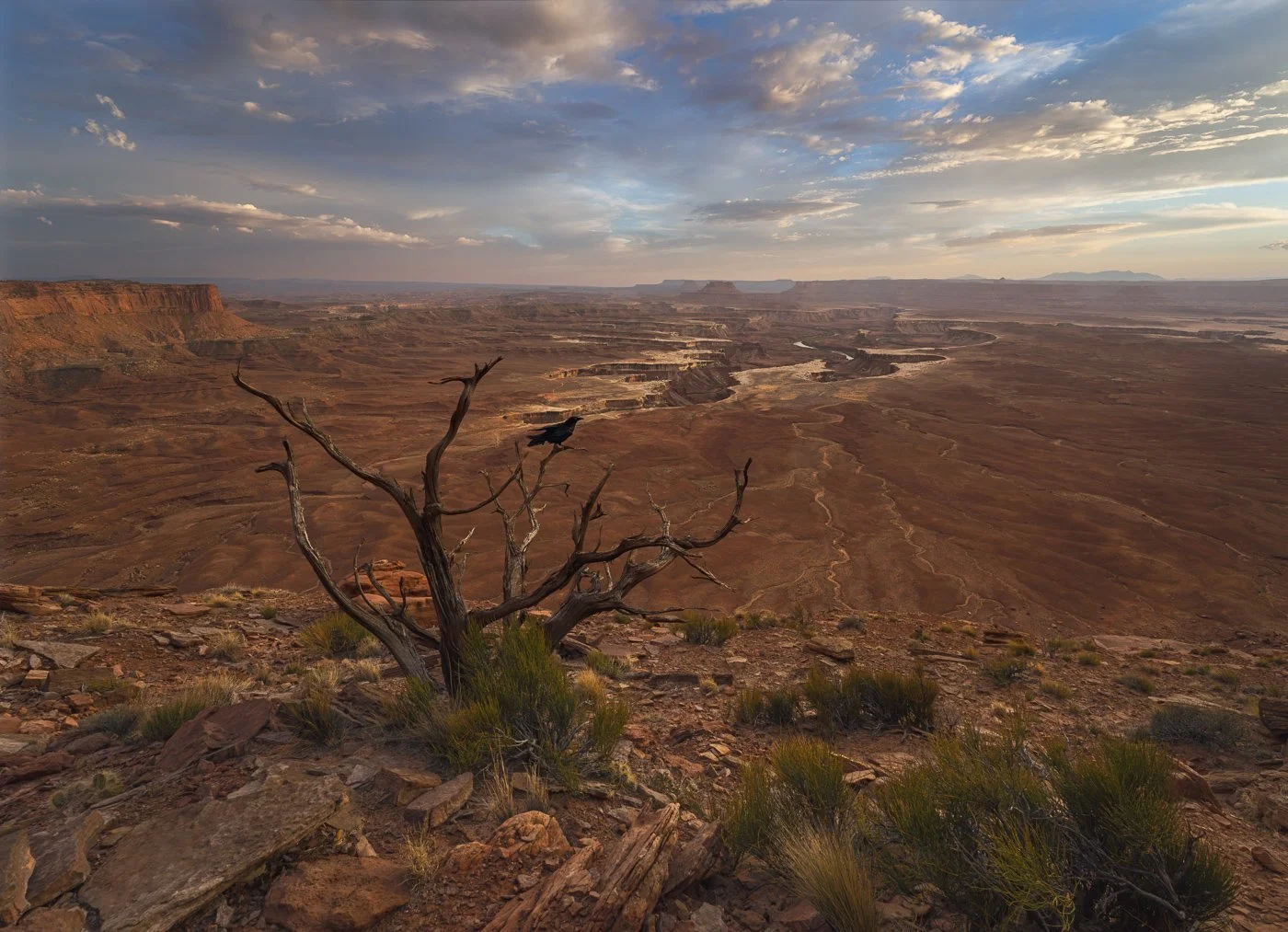
Dropping from the thermals to a skeletal juniper throne, a lone raven takes his post. In the vastness of Canyonlands, he acts as a sentinel for the sacred silence below. For fiteen seconds, the wind stilled and the light broke through, as if the desert itself was holding its breath under his watch.
The Raven’s Vigil: A Surreal 8-Second Encounter at Green River Overlook
There is a specific kind of exhaustion that comes with being a landscape photographer. It’s the weight of the gear, the hours of driving, and the mental tax of chasing light that might never show up. A few nights ago, I almost stayed home. The wind was howling, the dust was rising, and the one-hour trek to the Island in the Sky district felt longer than usual. But the conditions just looked too good, with heavy clouds leaving a gap right at the western horizon. And in Moab, if you ignore that gut feeling, you usually regret it. I headed to a remote cliffside spot near Green River Overlook—a place I’ve scouted and returned to several times over the last couple of months—to check on a specific skeletal juniper tree I’d discovered.
The Reward for Showing Up
As the sun descended, the wind whipped up a fine red dust, creating a thick, atmospheric haze over the canyon floor. Because I’d previously scouted this spot, I knew exactly how I wanted to compose the image and where I’d need to setup my tripod. I made several images in the quickly changing light. Suddenly, a lone raven appeared, riding the thermals, its black silhouette dancing against the deepening sky. I had a fleeting, almost impossible thought: "What if he landed on this tree?" In landscape photography, we often talk about luck, but I prefer the term anticipation. I immediately bumped my ISO to 400. I needed a faster shutter speed to freeze the motion just in case he decided to cooperate. Seconds later, he glided in from the left, wings spread wide, and landed on the weathered limb. For eight seconds, the world went silent. He looked at me, then out at the landscape, finally posing in profile before launching himself into the canyon. I clicked the shutter, capturing this incredible moment before he vanished into the dusk.
"In Native American mythology, the raven is often a creator, a trickster, or a guardian. Standing there on that cliff, with my back literally against the rock wall, it felt like a guardian was acknowledging the hours I'd spent scouting this single, lonely tree."
Why Scouting is Your Most Valuable Gear
People often ask me how I "find" these shots. The truth? I found this tree two months ago. I noted how I could compose the image with the limbs framing, but not intersecting, the canyon fingers below. I used the Photo Pills app to identify precisely where the sun would rise and set, giving me insight into what would be the best time of day to photograph this location. I knew that at the right focal length—using my Sigma 14-24mm—I could compose an image both vast and intimate, using the tree as a foreground anchor above the seemingly inifinte canyon below. Because I had scouted the spot, I didn't have to fumble with my composition when the bird landed. I already knew where my tripod legs needed to be.
Technical Breakdown
Camera: Sony A7IV
Lens: Sigma 14-24mm f/2.8 DG DN Art @ 14.8mm
Tripod: Peak Design Pro Tripod Tall
ISO: 400
Settings: 1/100s @ f/11
The "Secret Sauce": By increasing the ISO to 400 I knew I would introduce a bit of noise but it was more important that the raven's feathers remained sharp against the soft, hazy background of the White Rim. It is easy to minimize noise using Adobe Lightroom’s AI Noise Reduction.
Want the exact GPS coordinates and seasonal light guides for spots like this? I’ve spent 20 years documenting the hidden corners of Moab. I put all that knowledge —including scouting tips and best times to visit—into my eFotoGuide. It’s designed to save you the "one hour drive" of uncertainty and get you straight to the magic.
Explore the eFotoGuide at MoabPhotoWorkshops.com
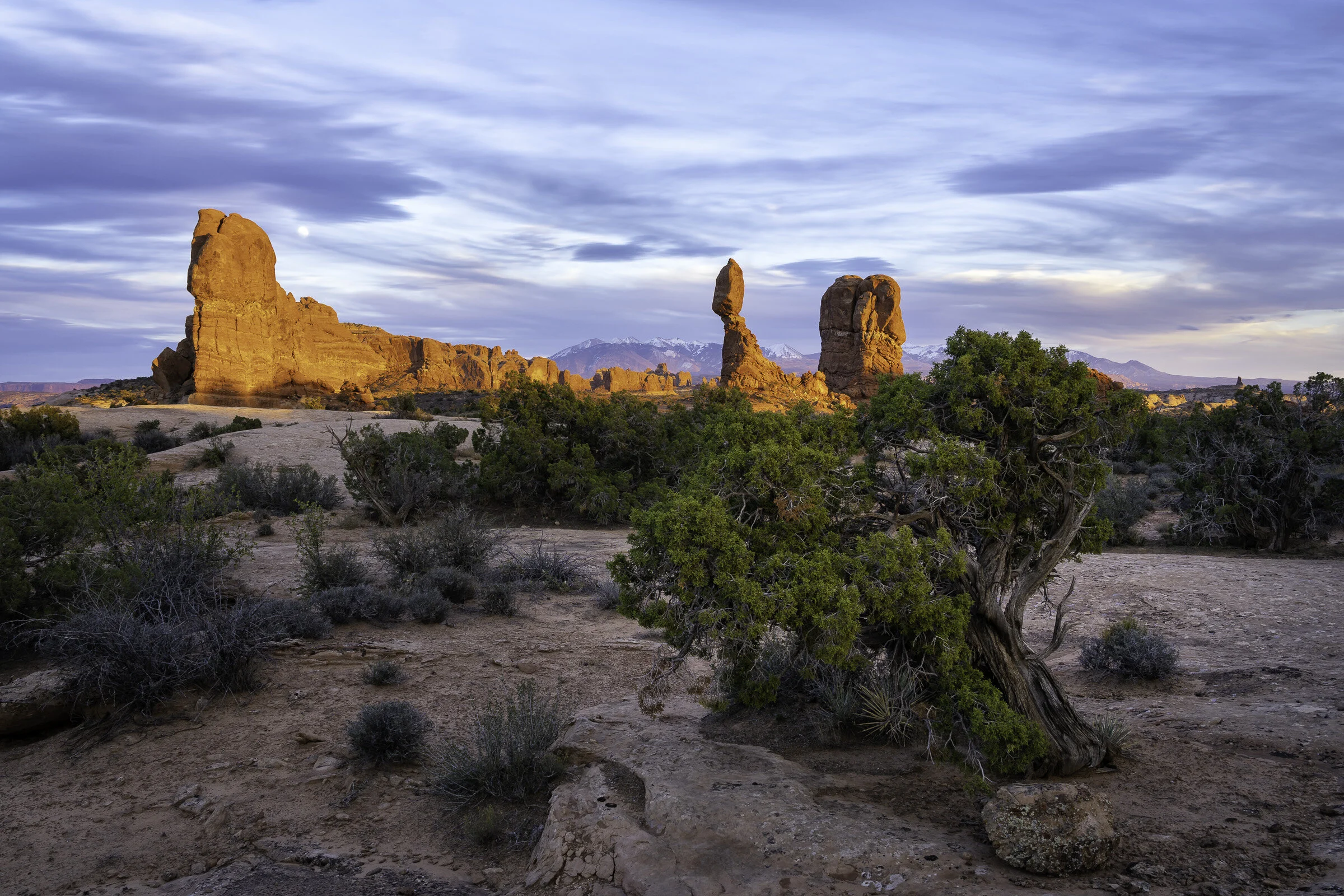
Behind the Image: Moonrise Over Balanced Rock and the La Sal Mountains
Professional landscape and adventure photographer Bret Edge takes you behind the image to discover how he created his latest image of the moon rising over Balanced Rock and the La Sal Mountains at sunset in Arches National Park near Moab, Utah.
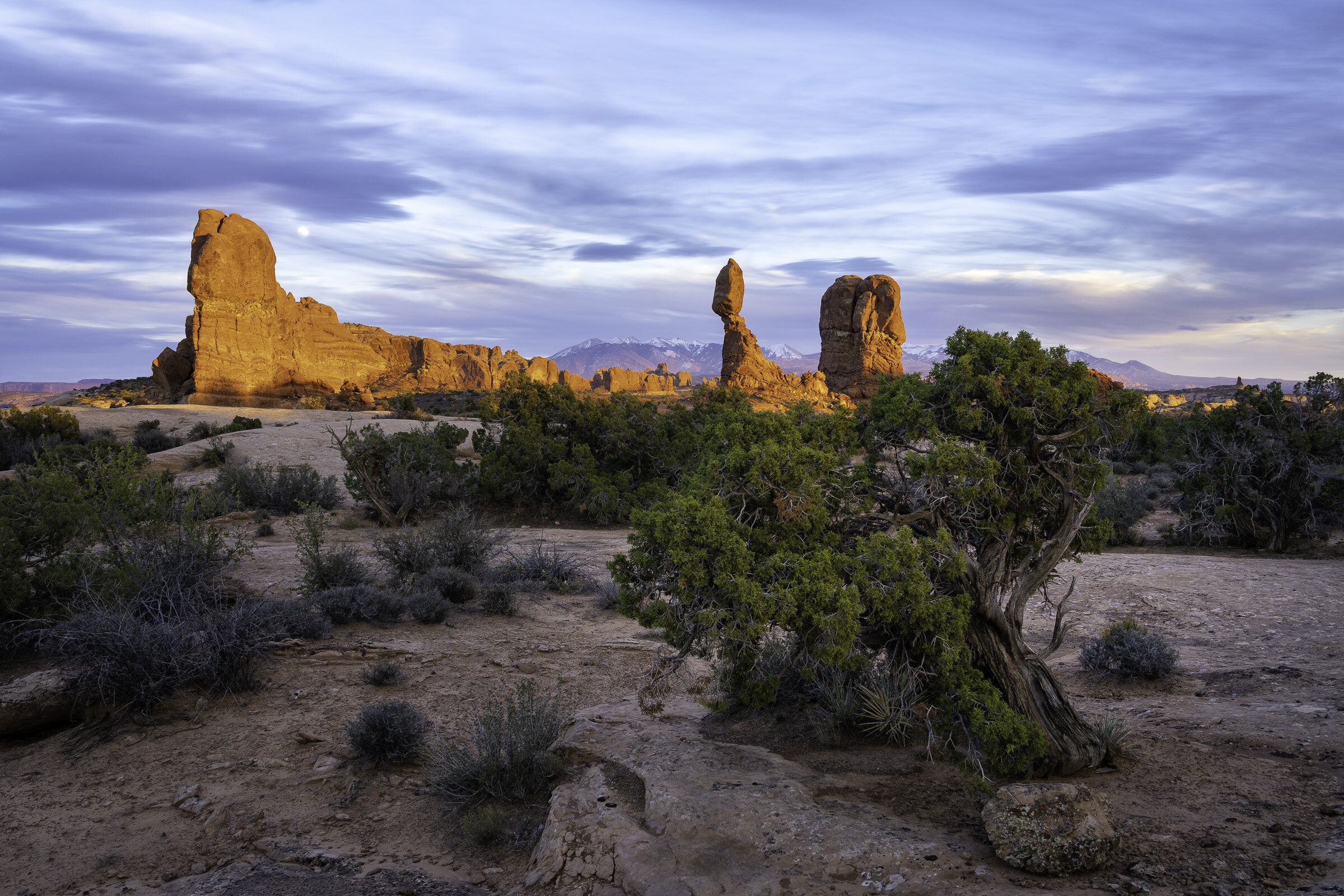
The moon rises over Balanced Rock and the La Sal Mountains as sunset warms the landscape with golden light in Arches National Park near Moab, Utah.
What is it about new gear that inspires us to run out and test drive it? Last week I received a Breakthrough Filters X4 Neutral Density 6 stop filter and for two days it burned the proverbial hole in my camera pack. Finally, on Sunday, clouds filled the sky and I predicted a nuclear sunset. Never mind that I’m not known for accurate sunrise/sunset predictions. I pitched the idea of a sunset picnic dinner to Melissa and Jackson, and they bit, so we packed up the Funhawg and headed into Arches National Park.
I didn’t have a plan. We got a late start and luckily, there was no line at the park entrance. About halfway to Balanced Rock we all agreed that hunger, rather than my photographic intentions, would be our guide. The cotton ball clouds from just an hour earlier had merged into a single sheet of gray on the western horizon. It was looking like I’d get skunked. But, at least we'd eat dinner in one of the most majestic dining rooms this side of…anywhere. We pulled into the picnic area near Balanced Rock and Melissa quickly turned out three gourmet sandwiches while I explored with my camera.
I’ve visited this same location dozens of times. I have multiple images of Balanced Rock in my portfolio, including one that was a consistent top seller during the four years we operated the Edge Gallery. Yet, within five minutes I stumbled upon the juniper tree in the image above and decided that it would make a fine foreground, as well as serving to camouflage the hot pink #vanlife Sprinter and other vehicles at the Balanced Rock parking lot. I affixed my fancy new filter to the lens, set up my tripod and quickly dialed in a composition that was much wider than any I’d previously photographed. I left my camera setup on the tripod while I joined Melissa and Jackson nearby to devour our sandwiches.
Just as I was taking the last bite, a wee little bit of light snuck through the western clouds. It was quite faint at first, just barely enough to cast a shadow, but I noticed it. I put down my plate and ran back to my camera just as the cloud curtains were pulled back, revealing a flood of neon light that washed upon the landscape for no more than a minute and a half. With the 6 stop ND filter on the lens and the camera set to ISO 100 and f/11, I borrowed just 13 seconds of that golden light to create this image. The long-ish exposure smoothed out the clouds gently floating in the sky above Balanced Rock and the La Sals, lending an air of surreality to the image.
This image is available as a fine art print on a variety of mediums in sizes ranging from 8” x 12” to 32” x 48”. Please contact me for pricing and to place an order.
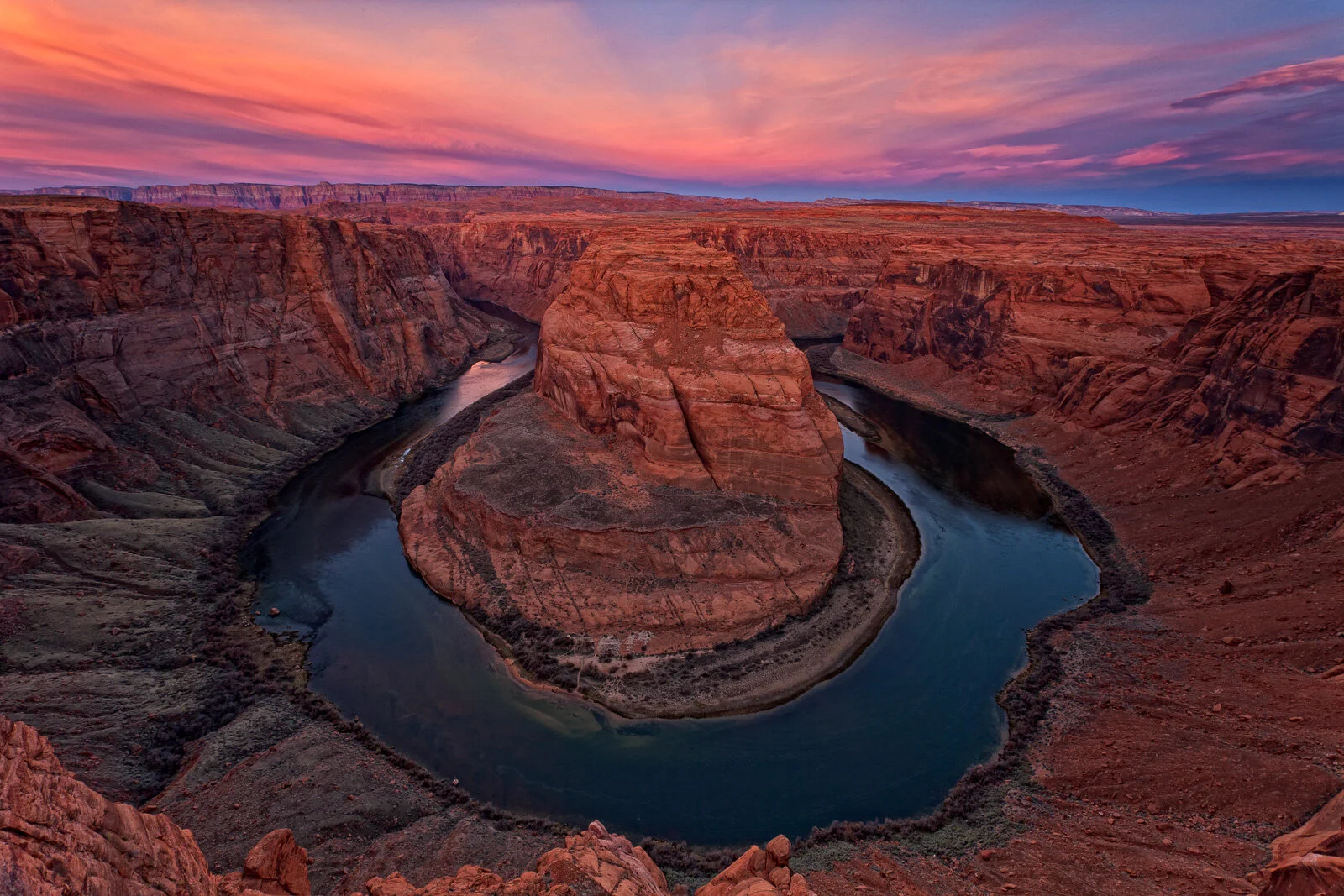
Behind the Image: Sunrise at Horseshoe Bend
Professional landscape and adventure photographer Bret Edge discusses the process behind the making of his image of a dramatic sky over the Colorado River at Horseshoe Bend near Page, Arizona.

Vibrantly hued clouds fill the sky above the Colorado River at Horseshoe Bend near Page, Arizona.
Video killed the radio star and tourism killed the icons of nature photography. There, I said it. I made this image in January of 2009. I arrived the evening prior and parked my truck in a corner of the dirt parking lot, spread out a ground sheet and tossed my sleeping pad and bag on top. It was a peaceful night but for a group of rowdy high school kids using one of the other corners for an impromptu desert party that didn’t last long.
I awoke before sunrise, hastily tossed my makeshift camp into the back of my rig and hiked out over the hill to this famous scenic view. I don’t remember a trail, per se, but maybe there was one. I recall following footprints through sand to the edge of the canyon rim overlooking the Colorado River, freshly brewed from the depths of Lake Powell just a hop, skip and a jump upstream. There were no drones. No fences, no busloads of tourists, no annoying selfie-stickers making peace signs and duck lips into their phone or GoPro camera - but there was one obnoxious raven. I assume the incessant squawks were the black-feathered beast’s way of telling this human kook to get off it’s lawn. Or maybe it was asking for a pop tart. Who knows? Either way, I’d been alone for a few days and frankly, I appreciated its company.
I’d never visited Horseshoe Bend but even then, twelve years ago, it was one of the Southwest’s most iconic vistas that every landscape photographer just had to memorialize in their own unique way. Like most of the icons of that time - the pre-Instagram era - it was still considered overdone. But, one could still visit and enjoy their own peaceful experience just as I did that chilly winter morning.
I had only that single morning to create a memorable image as it was my final day on the road and a long drive back to Moab awaited. Clouds to the west slowly started to glow. Faint, pastel pink at first. Then, second by second, the color intensified. I placed my tripod in the holes left by the thousands of photographers who preceded me and began to abuse the shutter button. Click. Click. Click. Though I was shooting digital and at that point HDR or exposure blending were the preferred methods of taming dynamic range my inner luddite still preferred to use clunky graduated neutral density filters. Click. Readjust the handheld GND. Click. Adjust exposure. Click. For a brief moment the landscape glowed in concert with the clouds. CLICK! Check the histogram - perfect. Zoom into 100% - nice and sharp. Got it! Good thing too, because while I was dotting i’s and crossing t’s, the light and color vanished.
I strolled along the rim, tripod over my shoulder and confidence soaring, raven still hootin’ and hollerin’. When the first small group of people arrived I took it as my cue to leave so they could enjoy their own peaceful moment with the canyon, and the damn raven.
Writing this, I realize that I’m becoming curmudgeonly. I turned 50 last November and I’m finding that the older I get, the less I like people. Maybe that isn’t entirely accurate. I think I still like people, I just don’t enjoy spending time around them as much as I used to unless they’re family or very close friends. I’ve seen so many of our favorite places around Moab become “discovered” and frankly, ruined. We find it harder and harder to drive, ride or walk out into the desert and find solitude. But, that’s probably a topic for a whole other blog post. This one is just a “behind the image” look with a few extra rants, I guess. Regardless, I hope you enjoyed it.
Behind the Image: Wildflowers in American Basin, Colorado
Professional landscape and adventure photographer Bret Edge discusses the process behind the making of his image of wildflowers blooming in American Basin within the San Juan mountain range of Colorado’s Rocky Mountains.

A wildflower garden of columbines, indian paintbrush, harebells and more bloom in verdant American Basin outside Lake City, Colorado.
American Basin. The name alone brings joy to the hearts of landscape photographers, especially those of us living in the American West. It’s the kind of place that’s being loved to death these days, for a variety of reasons, and the last time we were there it had lost much of its charm. RZR’s were parked all over the meadows, the flowers were being trampled by wannabe IG influencers and one had to watch one’s step to avoid piles of human excrement. Back in 2011, when this image was made, things were different.
We camped in the parking lot, within earshot of an ice cold creek whose rushing waters lulled us to sleep at night. Stars filled the sky and the warmth of mid-day sunshine gave way to near freezing temperatures as soon as the basin fell into shade. We arrived in the afternoon and began filling water bladders and organizing packs for the next day’s adventure - summiting Handies Peak, one of Colorado’s “14’ers”. Jackson was about 2 1/2 years old and I would carry him most of the way to the top, allowing him to hike as much as his little legs and lungs were capable. Melissa made a delicious meal of freeze dried something or other on the camp stove that night. Jackson, not yet old enough to understand that the camp stove remained hot after the fire was turned off, managed to grab it and immediately let out the kind of cry that every parent instantly recognizes when their child is in real pain. Luckily, his contact with the stove was short and his hand wasn’t badly burnt. We carry a well-stocked first aid and trauma kit when we travel and were able to soothe the minor burns with burn gel. Shortly thereafter we climbed into our roof top tent and quickly drifted off to sleep.
The Rockies are known for afternoon summer thunderstorms and we got an early start for the summit to give us plenty of time to make it up and back before rain and lightning arrived. The hike went well and Jackson arrived at the summit under his own power and to many cheers from a small crowd gathered atop this lofty mountain. Some snacks, the requisite summit photo and then the descent. Ominous clouds were just starting to blow in when we made it back to camp. Fortunately, the storm brought little more than a few raindrops, some distant thunder and my favorite conditions for photography - storm light!
Though I was exhausted from the hike I grabbed my tripod and backpack and wandered off into the meadows in search of brilliant wildflower gardens. I didn’t have to wander far. Using a Canon 5D Mark II and the venerable 24-105mm lens I got to work developing a composition that included wildflowers, creek, mountains and sky in a single frame. I experimented with portrait and landscape compositions, moving the camera left/right and up/down until I settled upon what I felt was the perfect composition. Handholding a Singh-Ray 3 Stop Graduated Neutral Density filter in front of the lens at 24mm, and using hyperfocal focusing techniques, I created this image. I used Adobe Lightroom and Nik Color Efex Pro to process the image. It went on to become one of my best selling prints and was breathtaking as a large canvas print.
Behind the Image: Sunset Light on Second Wave
Professional landscape and adventure photographer Bret Edge discusses the process behind the making of his image of the Second Wave in the Coyote Buttes area on the Utah/Arizona border.

A warm winter sunset splashes light on the Second Wave in the Coyote Buttes region of the Vermillion Cliffs National Monument, Arizona…or Utah?
When a friend calls you with news that he has a permit to hike into the Wave, and then invites you to join him on that hike, you do whatever you need to do to make it happen. Such was the case in early 2009, when my buddy Jim Talaric invited me to join him and a couple other photographers on a short trip throughout the Page area. My wife was very pregnant, but she was also very understanding, and encouraged me to join the guys on what would be a whirlwind tour of several areas I’d always wanted to visit…but hadn’t.
I worked a night shift and then drove from Moab to Page, where I met up with Jim and the other guys at a restaurant just in time for breakfast. We enjoyed some camaraderie and came up with a rough plan: first, we’d convoy to White Pocket where we’d spend a day and night, then we’d head to the Wave the following day. After that, we’d split up as some of us had places to be while the remaining dudes would visit a couple more spots.
February in this area can be quite cold, as was the case during our trip. The memory foam pillow I brought was hard as a rock each night we camped, but I was so exhausted from having worked late and then drove straight through that I had no trouble sleeping. We awoke early for the hike into the Wave, following a decent trail at first, and then moving from one cairn to another over broken sandstone until arriving at the bottom of The Wave.
Though I enjoyed my time at The Wave, I found the little side canyons even more interesting to explore. After a couple of hours, we kept heading uphill to visit other locations, including this spot, unofficially named The Second Wave. Made popular by the controversial photographer Michael Fatali, the Second Wave is taffy-like sandstone feature that glows for a few minutes each evening while basking in sunset light. I and one of the other photographers decided to stay here for the sunset as the rest of our crew wisely decided to hike out in the waning light. Today, i can say that I’m glad we stayed. That evening, I wasn’t so certain.
The hike out was…interesting. There were many steep areas to scramble down, and it was dark. Very dark. We had only a small circle of light from our headlamps to illuminate the “trail”, which consisted of nothing but sparsely spaced cairns for the first two thirds of the hike out. Surprisingly, we didn’t get lost nor did we suffer any catastrophes on this section, the most difficult of the entire trail. It wasn’t until we reached the actual trail, which during the daylight is easy to follow, that we managed to get turned around.
The trail gradually descends to a wash and then climbs back out the other side a short distance to the trailhead. We realized that we had taken a wrong turn when we ended up on top of a tall cliff overlooking the wash that we needed to cross. Being dudes, it made more sense to pick our way down the cliff than to follow the ridgeline back to where it would eventually intersect the trail. By the grace of God, we managed to negotiate the cliff with only a few scrapes from the occasional missed step and subsequent gravity driven slide. We hit the wash, took a right and followed it until intersecting the trail which delivered us uneventfully to the trailhead where our buddies were kindly waiting. They shared that they had seen lights bobbing down a cliff and asked if it was us. A little bit ashamed, we answered in the affirmative. All’s well that ends well.
I had this image printed large and on canvas and it hung for four years in my gallery. I was sure that it would be a hot seller. My wife disagreed, and she was right. In the entire four years that the Edge Gallery was open, I can count on one hand the number of times we sold this print in any size. I have to wonder if all the work, blood, sweat and tears that I put into making the image clouded my judgment?
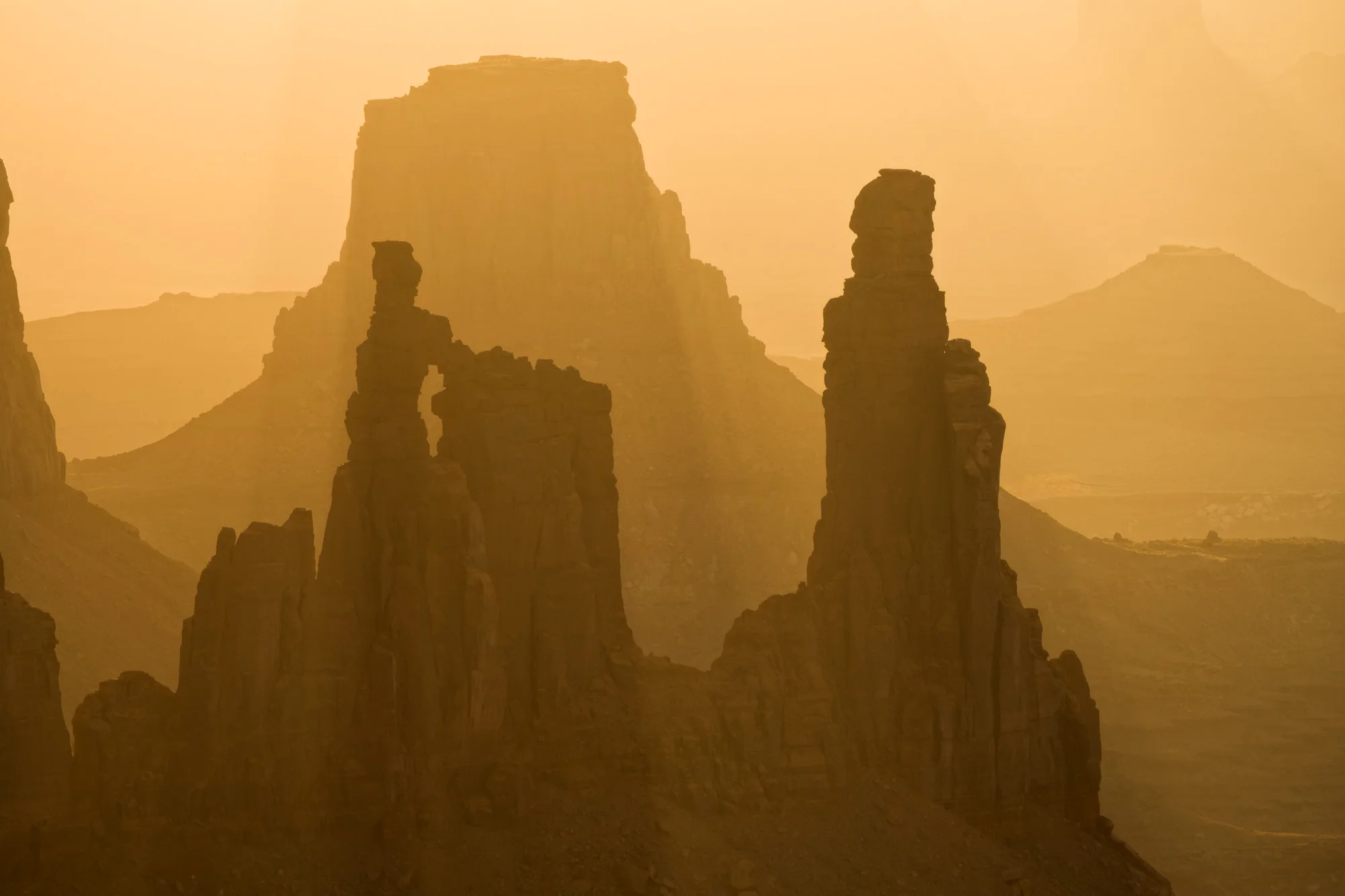
Behind the Image: Washer Woman Arch and Monster Tower at Sunrise
Professional landscape and adventure photographer Bret Edge discusses the process behind the making of his image of Washer Woman Arch, Airport and Monster Towers backlit in golden haze below Mesa Arch in Canyonlands National Park near Moab, Utah.

Washer Woman Arch and Monster Tower at Sunrise, Canyonlands National Park, Utah
Photographers are a funny bunch. The average person gets up in the morning, walks outside and sees sunshine and blue skies and thinks, “Man, this weather is awesome!” Photographers, on the other hand, see a vast canvas of B-O-R-I-N-G. We want storms, cotton candy clouds and drama! Caveats apply, of course, i.e. nobody in their right minds wants to photograph a slot canyon when storms are looming. I mean, I’ve done it and I almost paid the price for it, but that’s another story.
On the day I made this image I showed up for sunrise at Mesa Arch, lined up in the dark alongside a handful of other photographers with our tripod legs intertwined and shoulders nearly touching, all of us eagerly waiting for that glorious red glow on the underside of the arch. We waited. And waited. And waited. We checked our watches to confirm that the time for sunrise had come and gone, but…where was the glow?
As has become common in the West, wildfires were ravaging a forest somewhere and thick smoke from the fire had found its way to Moab. The canyon below Mesa Arch was hazy and it became clear that there would be no glowing arch today. Several of my fellow photographers packed up and left, a few stayed in place and burned through memory cards, and I decided to walk the canyon rim.
As I walked, I noticed that early morning sunlight coming through the haze created a warm, golden glow while backlighting created dramatic silhouettes of arches and towers in the canyon below. These features are typically viewed through Mesa Arch, which itself is usually photographed with a wide-angle lens. In those compositions, the arch is the main element while the other features nearly disappear due to the way very wide focal lengths exaggerate foregrounds while minimizing backgrounds. It occurred to me that an opportunity for a truly unique image was presenting itself. I’d be a fool not to take advantage of the conditions, so I put down my pack, got out my 100-400mm lens and attached it to my camera.
I’m a huge fan of using long lenses for landscape photography. They allow us to hone in on interesting scenes, extracting a tiny slice from within a big landscape. With the camera and lens on a tripod I found myself moving left and right, trying to frame Washer Woman Arch, Monster Tower and Airport Tower in just the right way to prevent overlapping or converging lines. When I finally succeeded, and I saw the image on the camera’s LCD screen, I knew I’d made some magic.
I can’t say that I’m the first person to photograph this view, but I’d never seen a version of it before. I led photography workshops in Canyonlands for many years, and I always enjoyed taking clients to Mesa Arch, helping them get the icon shot, and then watching their eyes really light up when I showed them how to create a similar image with their own telephoto lens!
Tech Specs: Camera, lens, Lightroom. ;-)
Canon 1Ds Mark II
Canon 100-400mm lens at 235MM focal length
1/20 sec at f/29
ISO 160
No filters
RAW, processed in Adobe Lightroom and Nik Software
This photograph may be licensed for commercial or editorial use and is also available as a beautiful fine art print in a variety of sizes. Please visit my contact page to inquire about pricing or to discuss print options.
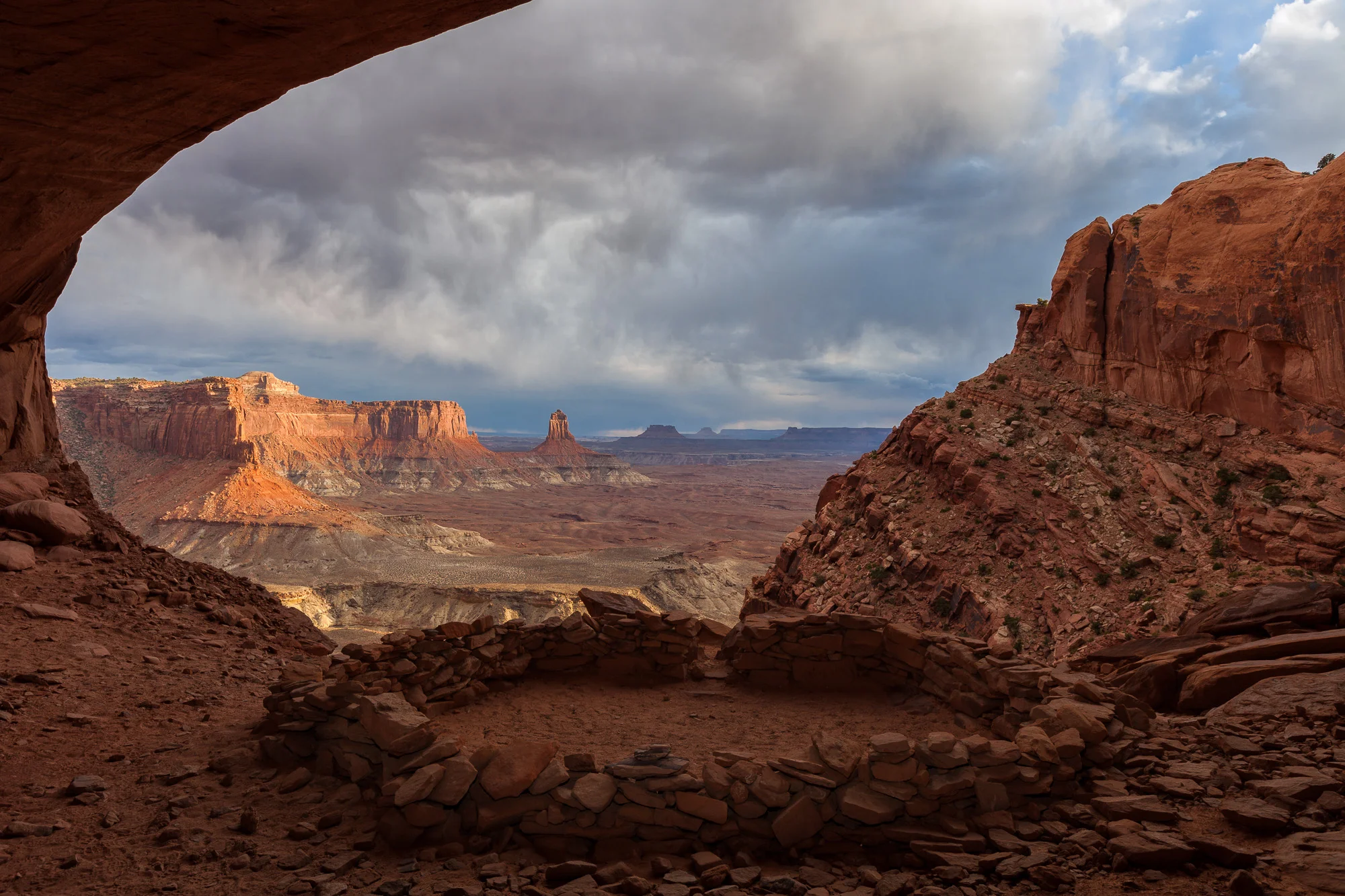
Behind the Image: Last Light at False Kiva
Professional nature and adventure photographer Bret Edge writes about the experience of creating his popular images of False Kiva in the Island in the Sky district of Canyonlands National Park near Moab, Utah.
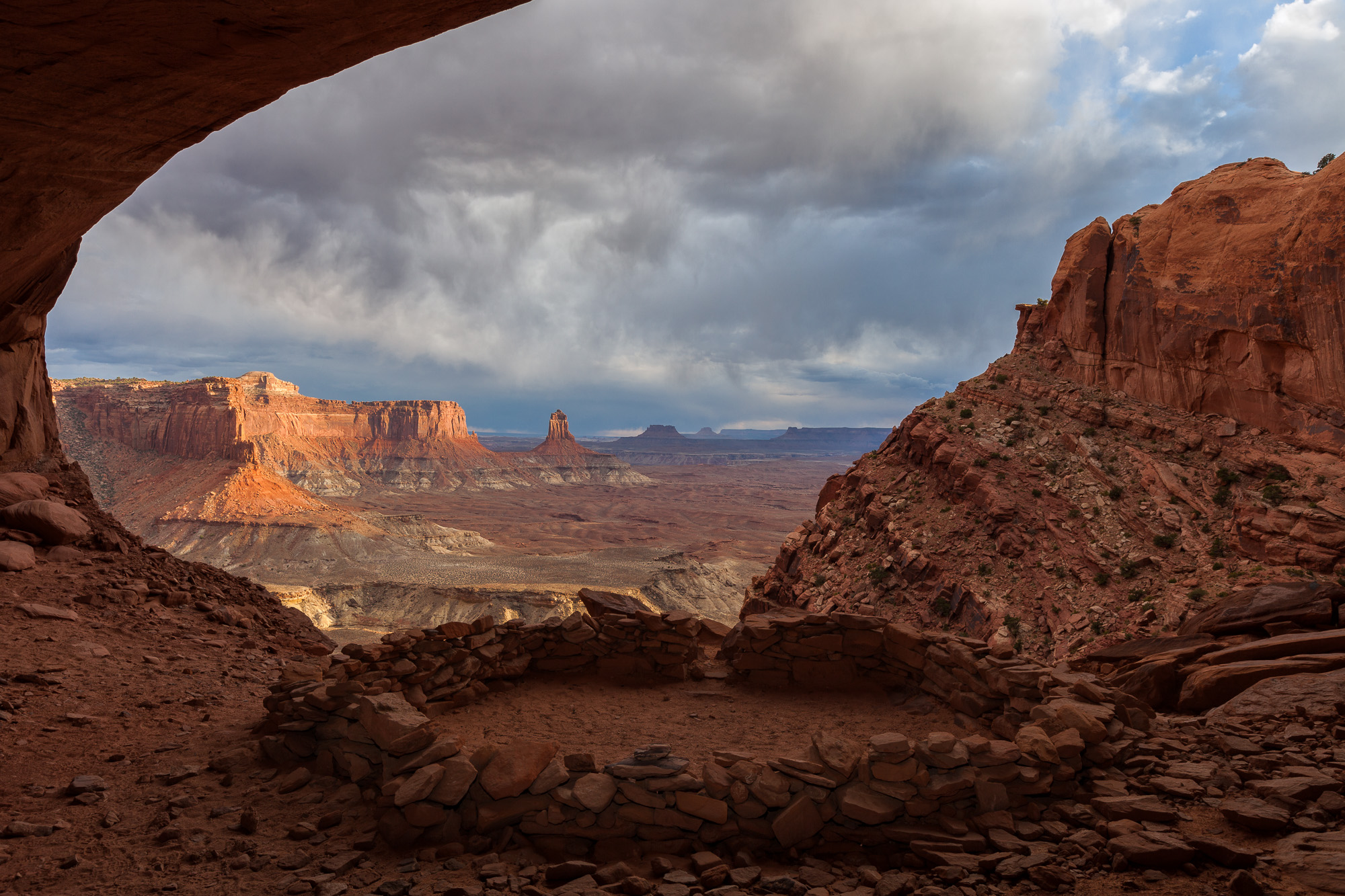
Last Light at False Kiva, Canyonlands National Park, Utah
Every once in a while I get lucky on my first visit to a spectacular location. The clouds, the light, the composition…everything just comes together magically and a beautiful new image is born. Such was not the case with False Kiva. I made the hike to this somewhat enigmatic ruin time after time, and while I enjoyed every visit, the conditions each time just never quite panned out. That is, until they did.
I made this image nine years ago in May, while hosting an informal gathering of photographer friends from an online forum in which I’d participated for many years. It was a weekend, and any weekend in Moab in May is guaranteed to be a busy one, this one included. We’d already visited a few spots before we decided to trek to False Kiva, and each location was pretty packed. Still, the general mood was cordial and everyone we ran into was friendly. That is, until we met Klaus.
In all fairness, Klaus wasn’t really unfriendly, he just exuded a sort of European arrogance and elitism - the kind you usually see depicted by a bad actor in a bad movie. Also, I don’t know if his name was Klaus but he was definitely German. Apologies to all the cool dudes named Klaus - no offense intended. At any rate, my group and I were headed down the trail when we came upon Klaus and his companion, both of whom wore heavy camera packs laden with tripods, and who were just starting the stiff climb out of the canyon from the ruins. We exchanged pleasantries, at which time Klaus decided he should inform us in the most haughty tone he could manage, that we had missed the best light and were wasting our time. I kind of blacked out for a second (not really) and don’t remember what happened next, but pretty soon Klaus was behind us and we were all standing in the alcove with the ruins before us, each photographer jockeying ever so politely for tripod space.
Time passed quickly with friendly conversation shared amongst the group, clouds building and threatening to prove Klaus’ prediction right. The canyon before us was blanketed in the soft, overcast light that is so perfect for macro photography, or waterfalls, but not grand landscapes. Even though it might be a bust, it was still a better way to spend an afternoon than working or running errands. And then, just as we were all about to give up hope, a beam of light pierced the clouds, illuminating a sliver of the landscape before us. Suddenly, the alcove went silent but for the sound of shutters opening and closing, one right after the other, until the light disappeared just as quickly as it had appeared. Looking around the alcove, I saw faces beaming with the same kind of light that had just splayed out on the landscape.
Moments in nature like this one are not common, nor would I want them to be, or we’d end up taking them for granted. Fiddy Cent probably isn’t the first person you might turn to for words of wisdom, but a couple lines from his hit song “Many Men (Wish Death )”, come to mind:
“Sunny days wouldn't be special, if it wasn't for rain
Joy wouldn't feel so good, if it wasn't for pain”
Unfortunately (or fortunately, depending on how you look at it), access to False Kiva has been restricted by the NPS and the location is no longer accessible to the general public. I’m thankful that I had the opportunity to visit and enjoy this incredible location.
Tech Specs:
Canon EOS 5D Mark II
Canon 16-35mm Lens @ 23mm
f/13 @ 1/20 second
ISO 100
Fill flash from Canon off-camera flash, model not known
No filters
RAW, processed in Adobe Lightroom and Nik Software
This photograph may be licensed for commercial or editorial use and is also available as a beautiful fine art print in a variety of sizes. Please visit my contact page to inquire about pricing or to discuss print options.
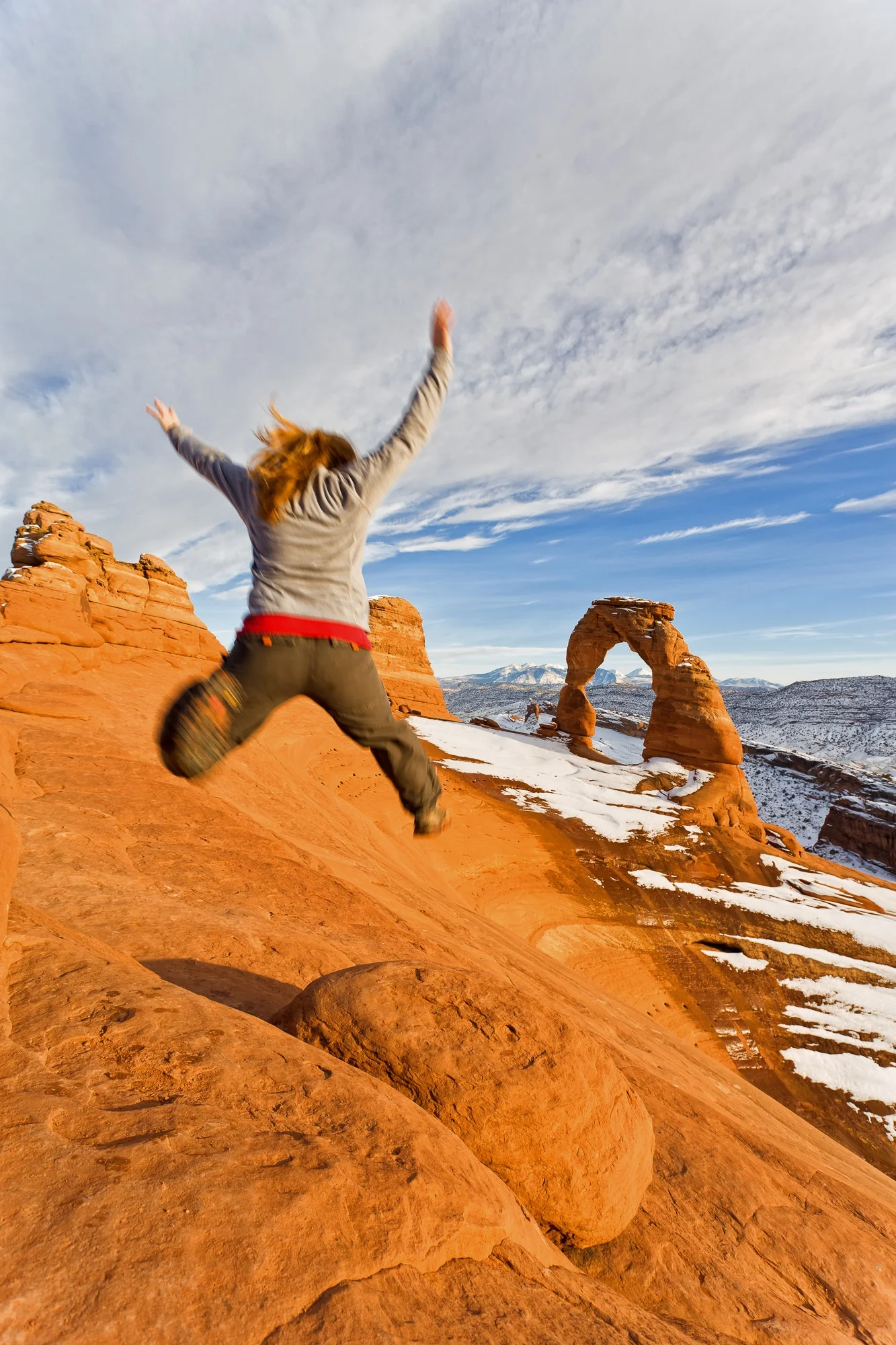
Behind the Image: Hiker Leaping at Delicate Arch
Professional nature and adventure photographer discusses what went into the making of his image of a female hiker jumping from rock to rock at Delicate Arch in Arches National Park near Moab, Utah.

Hiker Leaping at Delicate Arch, Arches National Park, Utah
I’m switching gears with today’s “Behind the Image” and sharing one of my first successful outdoor adventure images instead of yet another landscape image. I hope you enjoy the change of pace.
Melissa and I moved to Moab in May of 2006. Our hiking boots were worn out by the end of summer. We were quickly enamored of our new home in the desert and took every opportunity to explore the nooks and crannies of this convoluted landscape, of which there are many. Of course, we hiked Delicate Arch…a lot. I asked Melissa to marry me under the arch on New Year’s Eve, 2004, so it’s a spot with quite a bit of sentimental attachment for both of us. It’s also a fun hike with an incredible scenic reward, even now when you’re typically sharing it with hundreds of other people.
Living in Moab and running off with Melissa to explore the area nearly every weekend gave me ample opportunities to practice adventure photography. Landscape photographers typically operate on the fringes of the day with maybe an hour at sunrise and sunset in which to make quality images. Shooting adventure photography provides an opportunity to shoot outside of the golden hour, with the potential to make marketable images all day long. And, it was something new and fun to keep me interested in photography.
Eleven years ago in February, we hiked to Delicate Arch for sunset after a recent snowstorm left the desert landscape wearing a cool, white blanket. I tried several compositions of Melissa in static positions, standing or sitting on a rock, gazing off at the arch. One of them worked okay, but they were all a little too boring. They certainly didn’t scream “adventure!” We started searching around for other opportunities when Melissa jumped from one rock to another when it hit me: that’s it! She had to do the jump a handful of times before we got one that worked. Good thing she’s got strong knees!
I’ve sold this image several times over the years. It’s been featured in travel brochures, magazines and used on websites. Definitely worth the effort!
Tech Specs:
Canon EOS 1Ds Mark II
Canon 17-40mm Lens @ 17mm
f/8 @ 1/125 second
ISO 100
No filters
RAW, processed in Adobe Lightroom and Nik Software
This photograph may be licensed for commercial or editorial use and is also available as a beautiful fine art print in a variety of sizes. Please visit my contact page to inquire about pricing or to discuss print options.
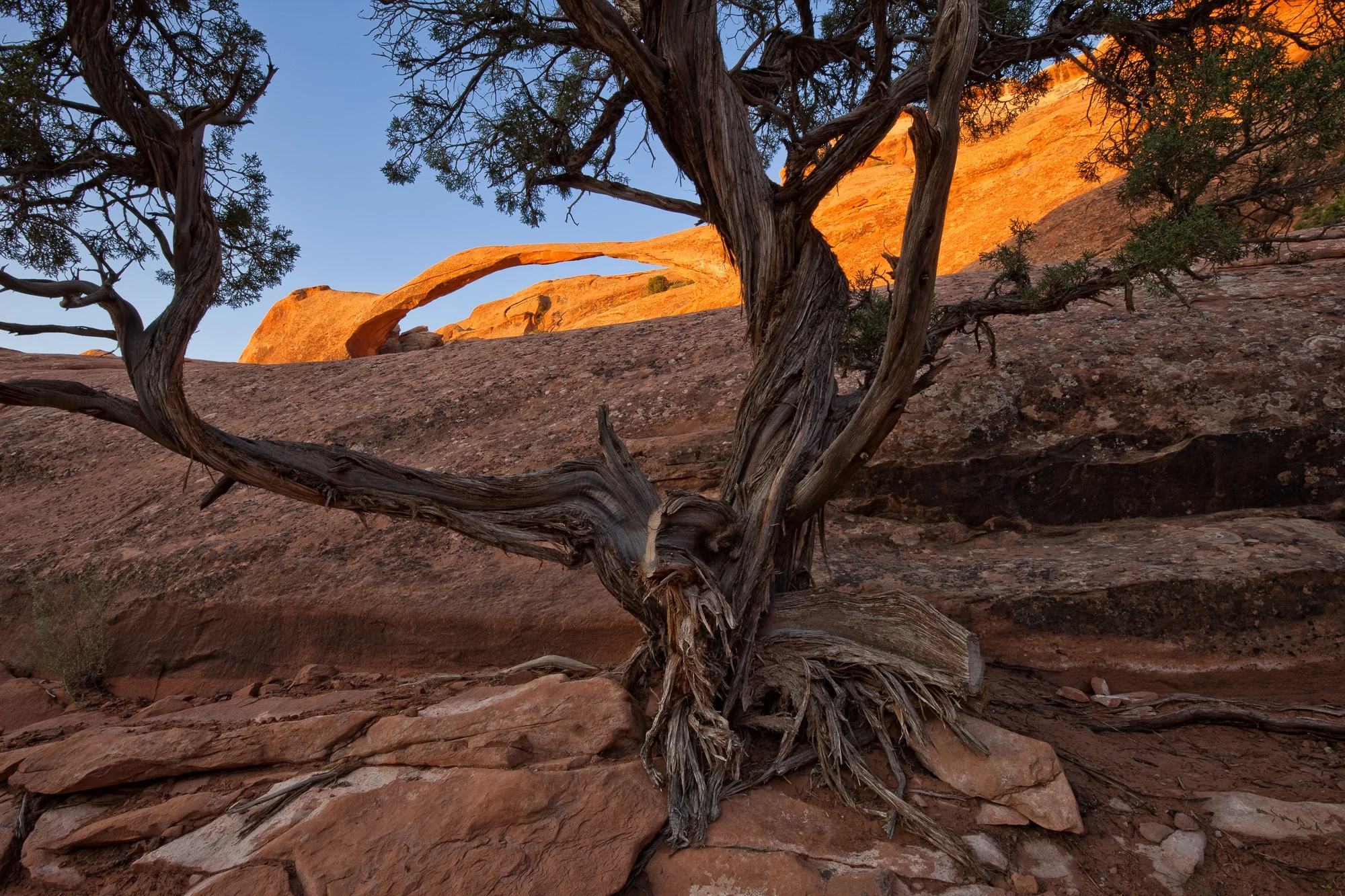
Behind the Image: Juniper Tree Framing Landscape Arch at Sunrise
Professional nature and adventure photographer Bret Edge writes about the process involved in creating his image of Landscape Arch framed by a weathered juniper tree in the Devil’s Garden area of Arches National Park in Moab, Utah.

Juniper Tree Framing Landscape Arch at Sunrise, Arches National Park, Utah
It’s no secret that I enjoy photographing icons, but not in the same way that they’ve been photographed thousands of times before. I love the challenge of arriving at a popular location and working to create something fresh and new that likely hasn’t been seen before. Such has been the case with Landscape Arch in Arches National Park. I’ve actually been able to create two unique images here - this one, and another that I’ll share at a later date. But about this image…
Landscape Arch is located in the Devil’s Garden area of Arches National Park, which is at the very end of the main park road. An easy one mile hike delivers you to the arch, which comes to life each day as sunrise paints the impossibly thin span of sandstone in warm, golden light. I had made the hike multiple times over the years and had always come away with the same boring compositions I’d seen posted all over the internet. I knew I needed to spend time scouting the location, getting up higher and down lower, looking at every possible angle.
One afternoon I hiked out to Landscape Arch and spent a couple of hours exploring as much of the area as legally possible. A couple decades ago a large chunk from the underside of the arch came crashing down, and the NPS wisely put up fences and signs to restrict access to areas under the arch. Some photographers don’t heed these warnings, but I’m not one to flaunt the law so I only scouted areas that were legally accessible. Despite my best efforts, I hadn’t found anything that excited me. I started hiking back to the trailhead and passed this little juniper tree that was literally, right. off. the. trail.
I stopped dead in my tracks. I’m a sucker for gnarly, weathered old trees and here was just such a specimen. Was it possible to frame the arch through the tree limbs?! I immediately squatted down and was thrilled to discover that not only was it possible, it was one of those “hot damn” moments! I knew where I’d be standing at sunrise the following day.
The next morning I hiked in before sunrise and was pleasantly surprised to find that I had the entire area to myself. I set up my tripod, locked the camera in place, fine tuned the composition and then sat quietly until the arch began to glow at sunrise.
I had a 24” x 36” canvas print of this image hanging in my gallery for all four years we were open and it was consistently a best seller. It also attracted the attention of photographers who wanted to know what camera I used and how I was able to maintain sharpness throughout the entire image. Simple: I used the appropriate aperture and the hyperfocal focus point.
Tech Specs:
Canon EOS 5D Mark II
Canon 16-35 Lens @ 17mm
f/16 @ 1/6 second
ISO 100
No filters
RAW, processed in Adobe Lightroom and Nik Software
This photograph may be licensed for commercial or editorial use and is also available as a beautiful fine art print in a variety of sizes. Please visit my contact page to inquire about pricing or to discuss print options.
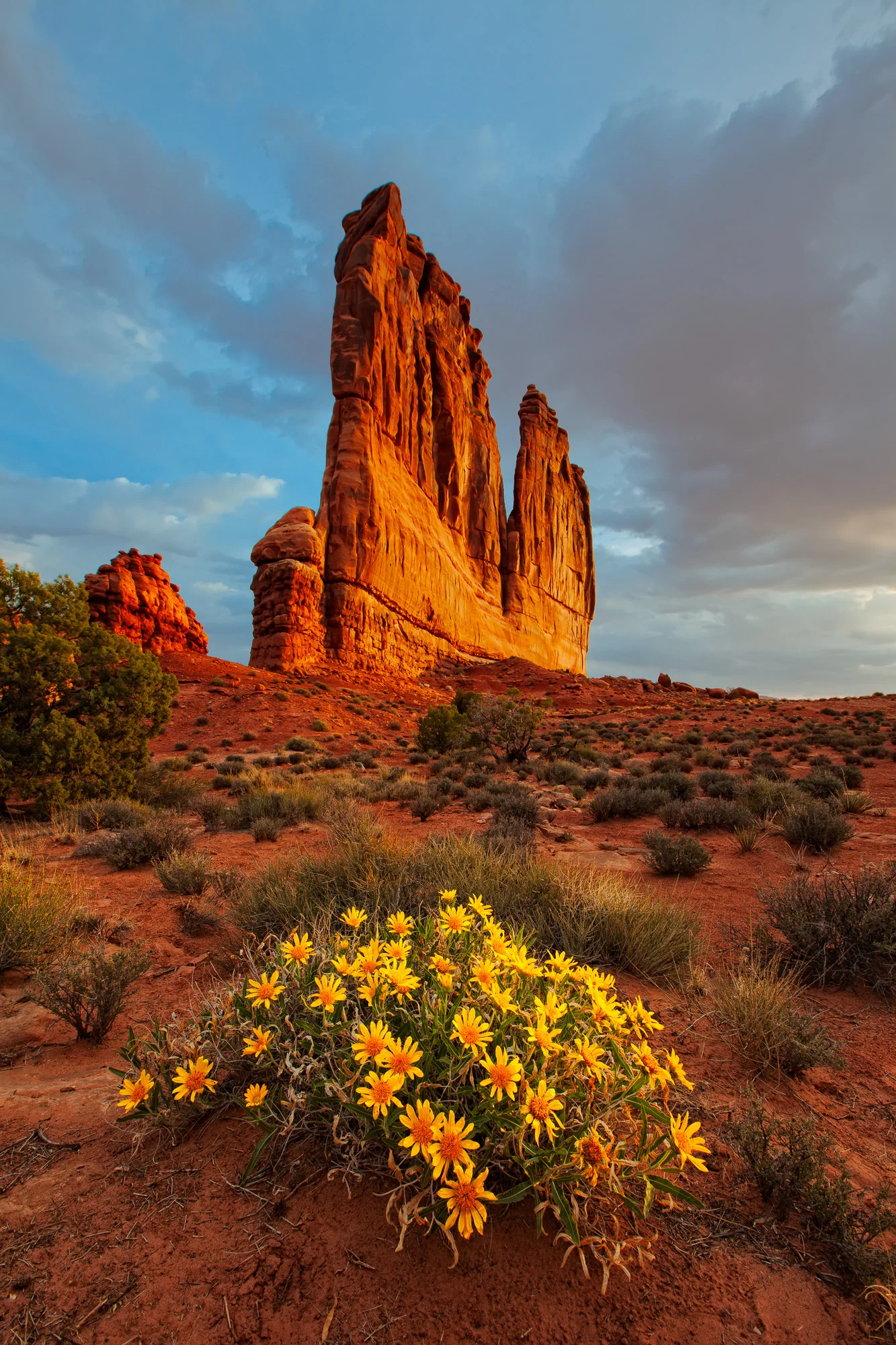
Behind the Image: Mules Ear Wildflowers Blooming Below The Organ
Professional nature and adventure photographer Bret Edge writes about the making of his image of mules ear wildflowers blooming below The Organ in the Courthouse Towers area of Arches National Park near Moab, Utah.

Mules Ear Wildflowers Blooming Below The Organ, Arches National Park, Utah
Some images require a photographer to hike through miles and miles of unforgiving terrain, in inclement weather, uphill both ways. This is not one of those images. Truth be told, one could almost quite literally park, fall out of the car and land on my tripod holes. But if that were the entire story behind the image, it wouldn’t make for a very compelling documentary so…read on.
There is another Moab photographer who made a similar image many years before I did. His photograph wasn’t bad, but it inspired me to create my own, and I wanted mine to be better. Now, I fully realize that “better” is subjective. Some people till, I mean, will prefer the other photographer’s image and I’m okay with that. I will say that after seeing this one come to life on my computer monitor, I felt that I’d succeeded.
Though easy access to the location doesn’t exactly make for a compelling story, I did have to clear a couple hurdles in creating the photograph, the first of which was…easy access. You see, every Bob, Jill and Johnny with a camera wanted to make this photograph and since it’s literally right off the side of the road, there were times when I’d show up and the lone bushel of mules ear wildflowers was already occupied. I also wanted an interesting sky, and since these wildflowers are at peak bloom for only a few days each year, the chances of all the elements coming together at the same time aren’t exactly awesome. But alas, one morning I showed up and the wildflowers were healthy and unoccupied and the sky looked promising. Shortly after setting up my tripod, BOOM…this image came was born.
I’m glad I persevered as this later became one of my best selling prints and greeting cards at The Edge Gallery. I still think I can improve upon it and will continue to try to do so. If/when I do, y’all will be the first to know. :-)
Tech Specs:
Canon EOS 5D Mark II
Canon 16-35 Lens
f/16 @ 1/8 second
ISO 200
No filters
RAW, processed in Adobe Lightroom and Nik Software
This photograph may be licensed for commercial or editorial use and is also available as a beautiful fine art print in a variety of sizes. Please visit my contact page to inquire about pricing or to discuss print options.
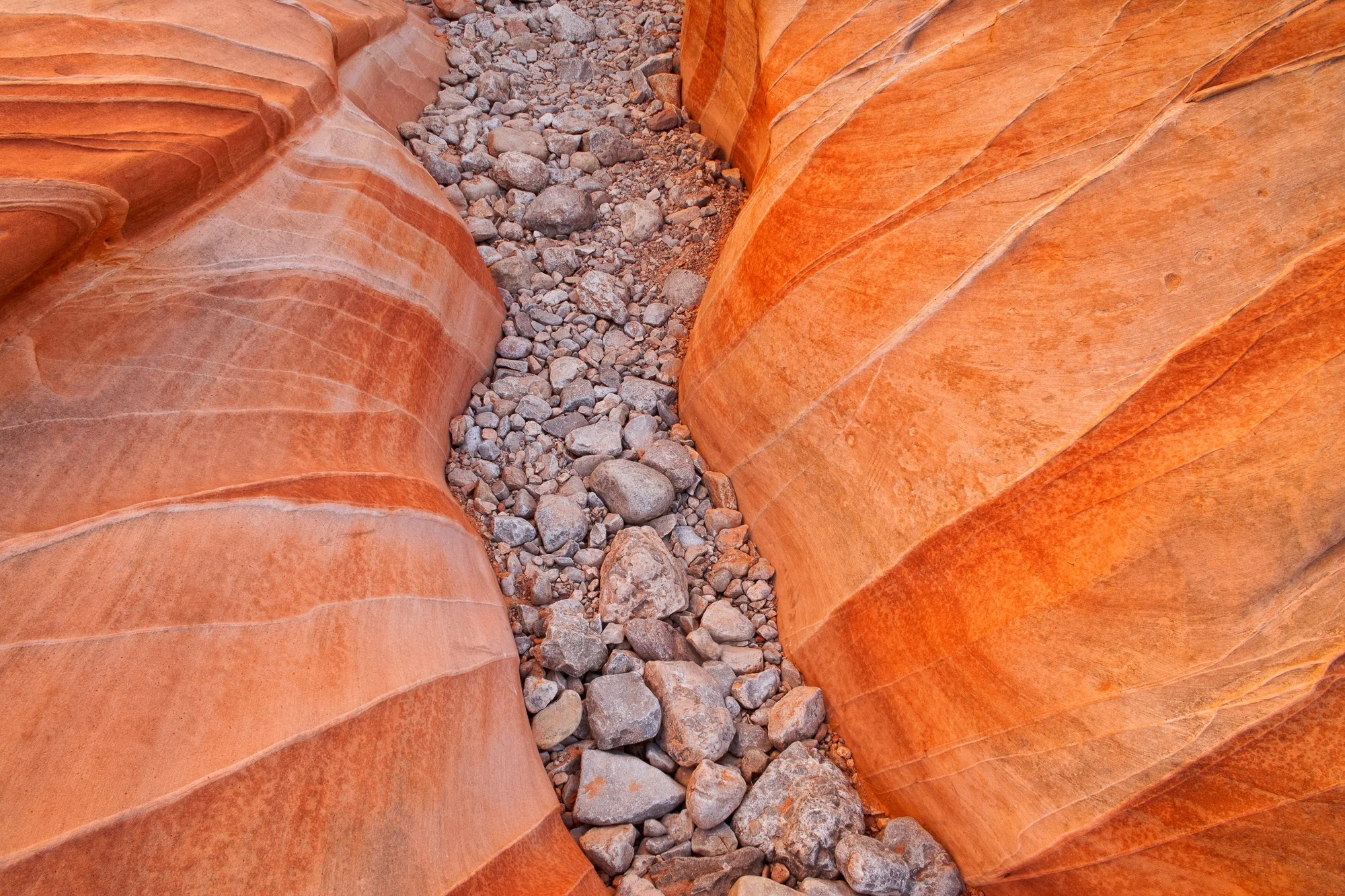
Behind the Image: Detail of Slot Canyon Floor in Valley of Fire State Park
Professional nature and adventure photographer Bret Edge writes about the making of his popular slot canyon image from Valley of Fire State Park near Las Vegas, Nevada.

Detail of Slot Canyon Floor, Valley of Fire State Park, Nevada
In the summer of 2005 Melissa and I spent almost four months road tripping throughout the West while living in a tiny little trailer we affectionately named “Harvey the RV”. We had no itinerary, just a general route that started in Denver, Colorado and went north to Glacier NP, west to Bellingham, Washington and then meandered south all the way to southern California, finally wandering back home through Arizona and Nevada. One of the great joys of traveling without a plan is the ability to look at a map, see something potentially interesting nearby, and just…go. Valley of Fire State Park was one such gem of a find.
We passed through Las Vegas, Nevada headed north on I-15, nearing the end of our trip, when we saw a small sign on the side of the highway for Valley of Fire State Park. The name certainly sounded interesting so we consulted the map and saw that the park wasn’t too far off the highway. Of course, iPhones and mobile internet weren’t really a thing in 2005 so we didn’t have the world at our fingertips like we do now. There was only one way to know if Valley of Fire was worth a stop: turn off the highway and point the truck toward the park!
As we all now know, Valley of Fire is very well worth visiting. I live in Moab and have traveled extensively throughout the Desert Southwest, and nowhere have I seen such colorful sandstone as this little park. Red, orange, white, yellow, purple - it’s as though a rainbow collapsed on this landscape and left its colors draped over the rock. The colors aren’t the only attraction, though. Slot canyons, arches, hoodoos, frozen stone waves - the features lend themselves quite nicely to an outdoor photographer’s eye.
Not having any familiarity with the park at all we decided our plan of attack would include hiking everything we could fit into a two day stay. One of the first hikes we did was the White Domes Loop, an easy 1.1 mile trail that included a short section through a somewhat unremarkable slot canyon. Unremarkable, at least until you exit the canyon and find yourself walking through the scene in the image above. It literally stopped me in my tracks. I was lucky in that the striped sandstone was the recipient of some really lovely reflected light - the perfect type of light for this scene. I tried several compositions, which wasn’t an easy task as I had to splay the tripod legs out over each side of the narrow channel between the sandstone and point the camera almost straight down. I’m not exactly a tall person, and the sight of me trying to glimpse the composition through the viewfinder had to be almost comical. Needless to say, I was pretty stoked to see this one on the laptop screen later that evening.
I believe I was one of the first to photograph this scene. At the time, Valley of Fire wasn’t the uber-popular destination for photographers that it is now, and social media didn’t exist to promote these places to the masses. In the years since I’ve seen quite a few versions of this image, some that are even better, but I’m proud of the fact that the only inspiration I had for my own image came from within.
Tech Specs:
Canon 1Ds Mark II
Tokina 28-70mm lens at 28MM focal length
1/8 sec at f/22 (I didn’t need f/22 but still hadn’t really figured out aperture at the time)
ISO 100
No filters
RAW, processed in Adobe Lightroom and Nik Software
This photograph may be licensed for commercial or editorial use and is also available as a beautiful fine art print in a variety of sizes. Please visit my contact page to inquire about pricing or to discuss print options.
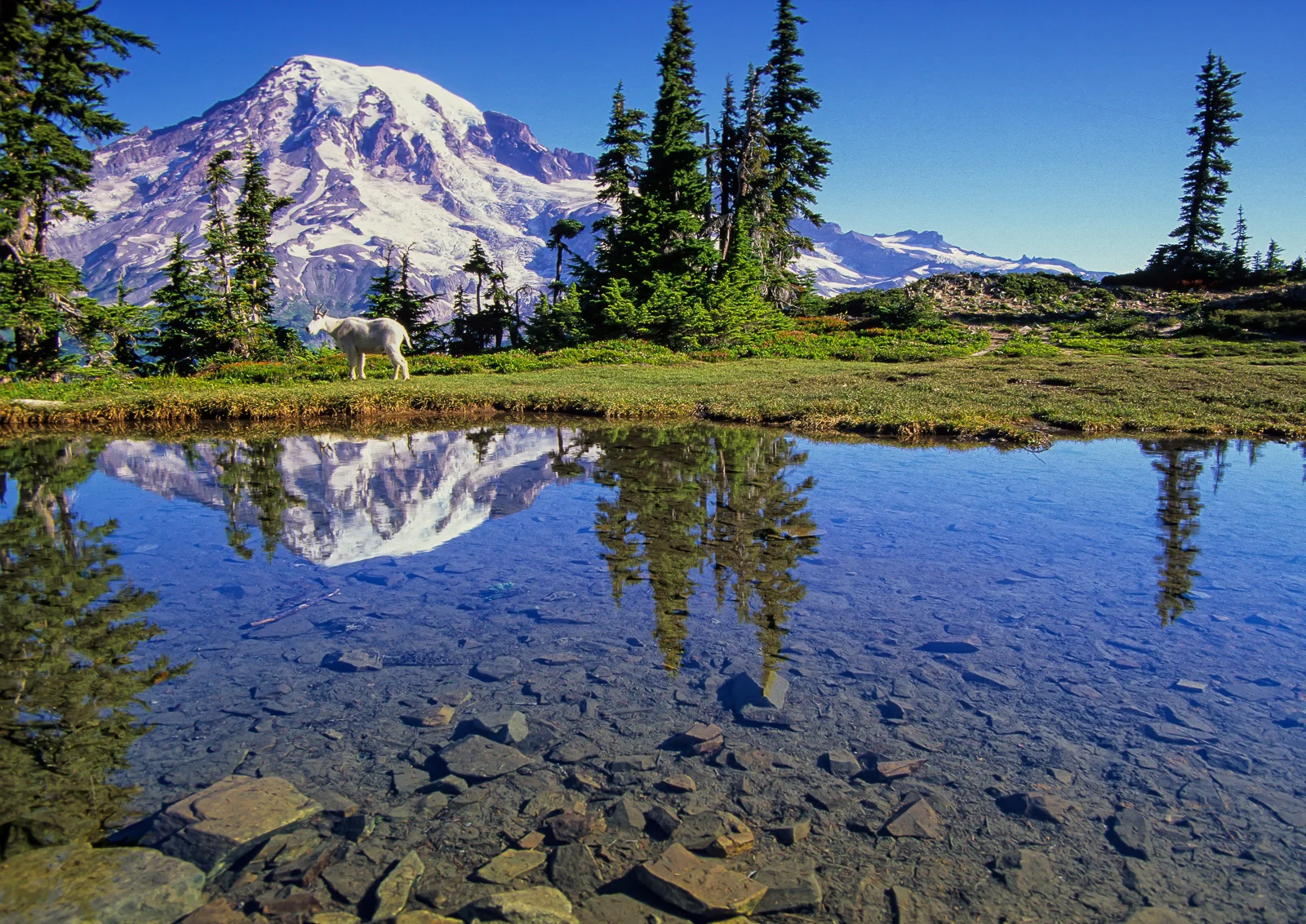
Behind the Image: Mountain Goat and Mount Rainier
Professional nature and adventure photographer Bret Edge discusses creating his image of a mountain goat and Mount Rainier reflecting in a tarn in the Tatoosh Range at Mount Rainier National Park in Washington.

Mount Rainier and Mountain Goat Reflecting in Tarn, Mount Rainier National Park
We’re going way, way back with today’s “Behind the Image” post - all the way to the summer of 2001 and Fuji Velvia 50 film. What you see here is the very first image I ever sold. Looking at it now, well…it’s kinda hard to look at, honestly. I’ve become so accustomed to viewing super clean, highly detailed digital images that I really struggle to lay eyes on photographs I made on 35mm film and scanned with a Nikon CoolScan film scanner. Factor in the less than awesome compositions of so many of those old images, including this one, and sometimes I feel like I’m watching a train wreck. However, back in 2002, when an ad agency purchased this for use as a large backlit sign in the Sea-Tac airport, it obviously caught someone’s eye.
And now, on to the back story. Several friends and I decided to climb Mount Rainier in August of 2001. About two weeks before our departure I fell walking down the stairs in my apartment and broke my right hand. No, I wasn’t drunk…just clumsy. Rainier is an alpine ascent, requiring that climbers utilize ice axes and be assigned to a rope team for safety. Given that I wasn’t able to hold a can of soda, there was no way I could self-arrest with an ice axe in a fall. Rather than cancel the trip, I went along with my friends and spent my time hiking while they spent several days training for and executing the climb.
On one of my hikes I stumbled upon this tarn high on a ridge in the Tatoosh Range, which sits just south of Rainier itself and affords spectacular views of the glaciated southern flanks of the peak. It was afternoon and the light wasn’t optimal so the next morning, I awoke long before sunrise, dragged myself out of bed and trudged up the steep trail in the dark. I quickly set up my tripod, composed a photo in the viewfinder and waited patiently in the chilly morning air for the first rays of sunshine to grace the mountain before me.
I had initially photographed a different, portrait oriented composition and after the sun was a bit higher in the sky I decided to try framing a landscape composition with less foreground but more of the ridge and trees to the right of Rainier (the composition above). No sooner had I locked the ballhead in place with this composition in the viewfinder when a lone mountain goat appeared on the ridge. I was so stunned that I literally forgot to press the shutter button. The goat wandered from the ridge, down toward the tarn and then proceeded to stand right in front of me, at which point the synapses started to fire again and I had just enough time to make one exposure before it wandered away out of frame.
In retrospect, the composition would have been a thousand times stronger if I had the presence of mind to press the shutter when the goat was standing on the ridge to the right of the mountain. Nevertheless, it’s a unique image that obviously has commercial appeal, so I probably shouldn’t be too critical of it.
I had been using the same lab to develop my film since I started shooting slide film and never had the tech commented on my work until I picked up the slides from this trip. I remember the tech saying, “You’ve got some really nice images in there” as he handed me the developed film. Needless to say, I rushed over to one of the light tables, threw my slides down and was pretty thrilled when I saw this one through the loupe!
Tech Specs:
· Canon 35mm film camera, model unknown
· Tokina 20-35mm lens, probably at around 20mm (not recorded)
· Shutter speed unknown at f/22
· Fuji Velvia 50
· Possibly a 2 stop graduated neutral density filter
· Scanned with Nikon CoolScan, lightly processed in Adobe Lightroom
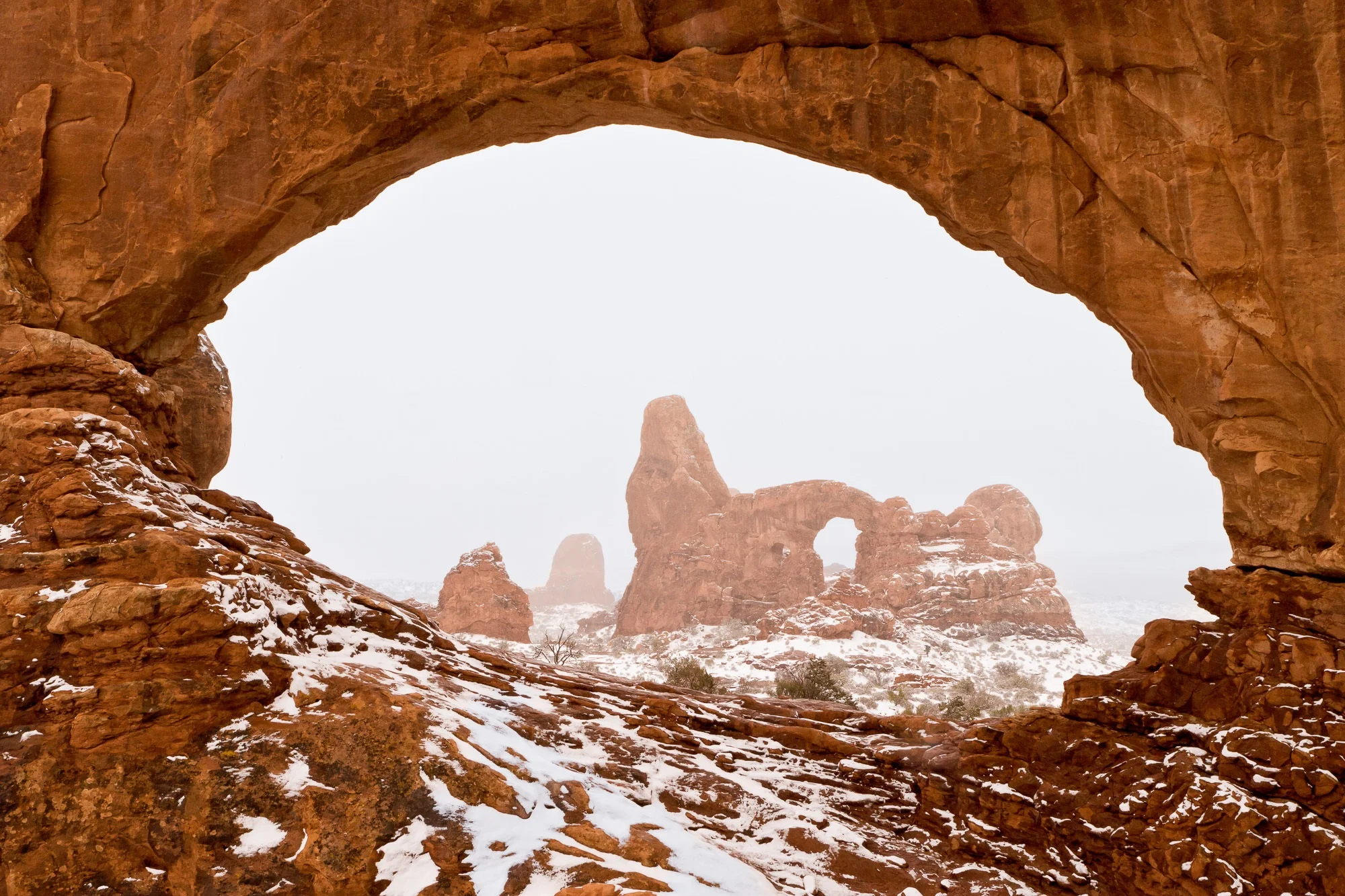
Behind the Image: Winter at the windows
Moab photographer Bret Edge reveals the story behind his popular photograph of a snow storm at the Windows area in Arches National Park near Moab, Utah.

Winter at the Windows, Arches National Park
New year, new site, new blog feature? Why not! With the recent launch of my new website I’ve decided to also reinvigorate the blog. By reinvigorate, I mean “bring back from the dead.” One of the features I’ll run regularly here will be “Behind the Image”, in which I will write about the making of one of my photographs. These will not be technical articles about how I used the hyperfocal point with a wide angle lens on a super awesome camera to blah blah blah. Rather, these will be the backstory - what I was feeling, why I wanted to photograph the location, my experience creating the photo, amusing anecdotes, etc. And yes, for those who just have to know, I will include the technical details.
I’m kicking off the series with this image of a snowy day in the Windows area of Arches National Park. I made this image on February 27, 2007, about six weeks after breaking my back in two places in a car crash. No, carrying a heavy camera pack while hiking on slick, icy terrain was not doctor approved but after spending weeks lying around the house I was flirting with insanity and knew that a quick jaunt to Arches would refresh my mental state. So, off I went.
If you’ve photographed Turret Arch through North Window you know that the scramble over exposed slickrock one must do to achieve this view can be a bit hairy even in good conditions. Doing it in snow and ice while carrying a pack on a recently broken back is just stupid. Nevertheless, I did it and luckily, everything turned out just fine.
I had envisioned warm sunrise light bathing the sandstone, which itself was freshly blanketed with pristine snow. It quickly became clear that wasn’t going to happen. Plan B? A moody image of fog and falling snow. I ran with it and made the image you see here. In retrospect, I’m thankful old Mother Nature guffawed at my original plan, something she is wont to do. I think this image is more unique, and if image sales are a good barometer I’d say my clients enjoy it, too.
I still recall the absolute peace and a very real sensation of gratitude I felt standing on that little knob of rock, snow falling all around me and the cold air chilling my face. The crash that broke my back easily could have killed me. It felt like I’d been given a second chance and at the time, I swore I wouldn’t waste it. For a while, I didn’t. But over time, work got in the way and excuses were easy to come by, and I kind of got off track.
As I type this I’ve got casts on both arms. Last November I fell off a small cliff while mountain biking with my family in Sedona. I broke both arms, a few ribs and suffered several other injuries. My head and face slammed into the rocks but were not seriously injured thanks to my helmet and sunglasses. Once again, I was lucky to be alive. It was another wake up call. This year, I’m resolving once again to make changes, to get outside more, to appreciate every moment I have with my wife and son. And, I’m dipping my toes back into photography. All the downtime over the last seven weeks has allowed me to revisit images, start writing again and build a new website. It’s stoked my creative fire for the first time in a few years, and that inner warmth feels damn good.
Tech Specs: Camera, lens, Lightroom. ;-)
· Canon 1Ds Mark II
· Canon 24-105mm lens at 35MM focal length
· 1/50 sec at f/22 (I didn’t need f/22 but still hadn’t really figured out aperture at the time)
· ISO 100
· No filters
· RAW, processed in Adobe Lightroom and Nik Software
This photograph may be licensed for commercial or editorial use and is also available as a beautiful fine art print in a variety of sizes. Please visit my contact page to inquire about pricing or to discuss print options.