
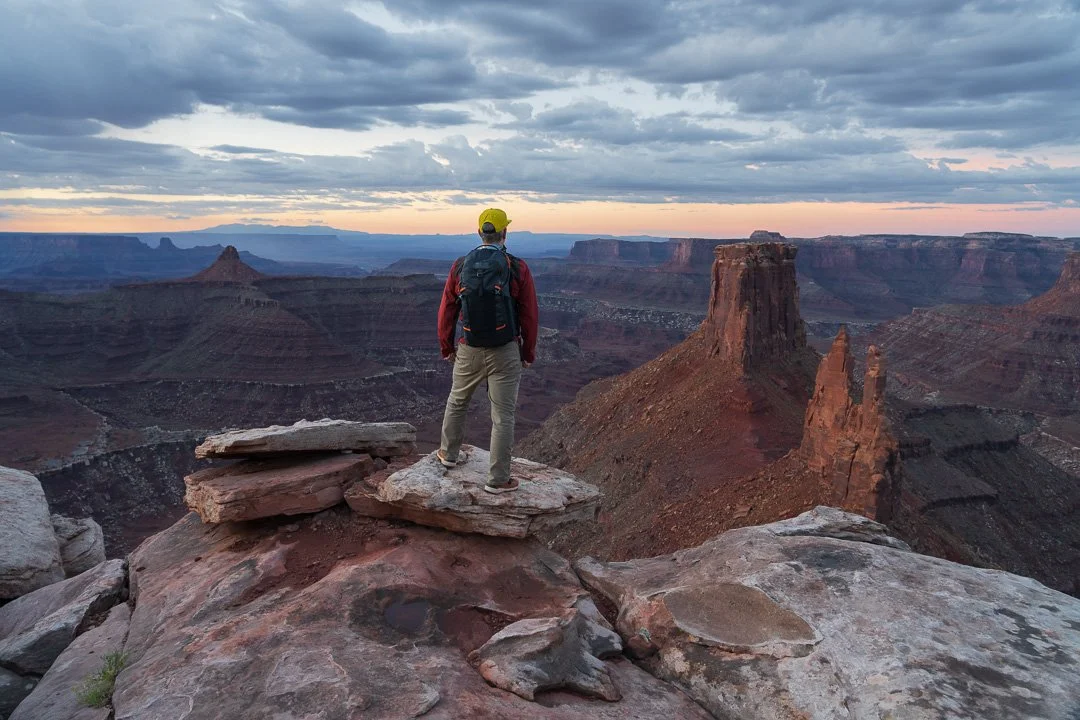
Self-portrait standing at the edge of Marlboro Point wearing the Cotton Carrier Hyker 25L backpack near Moab, Utah, taking in the expansive desert canyons and towering rock formations at twilight.
Outdoor photographers collect backpacks like squirrels collect nuts, burying the old one in a garage or closet every time a shiny new pack arrives. Then, we return to our midden and dig up one of the old packs when the latest one leads to disappointment. I know, because I’ve been caught in this cycle for the last twenty five years.
Every once in a while though, we find a unicorn. A pack that fits right, carries comfortably, has most of the features we’ve longed for, is built to last and doesn’t put too big of a dent in your checkbook. I may have found that unicorn.
Earlier this summer Cotton Carrier launched the Hyker 25L, the first backpack in the brand’s highly regarded history. They’ve been around for 17 years and are most well-known for their camera harnesses, which are consistently praised for comfort and ease of use. While Cotton Carrier aren’t new to the game, there’s a massive difference between a camera harness and a backpack. Could they take their success with harnesses and carry it over to backpacks? Spoiler alert: they did. Big time.
To be completely transparent, Cotton Carrier gave me the Hyker 25L backpack and a camera cube for this review. I received no additional compensation and I made it clear that my review would be truthful, for better or worse. They will see this review for the first time when I publish it. I asked Cotton Carrier to give me at least a couple of months to use the pack before writing my review because, well, writing a review after wearing a pack once or twice is damn near fraudulent. After three months of use, I feel like I can write a well-informed review.
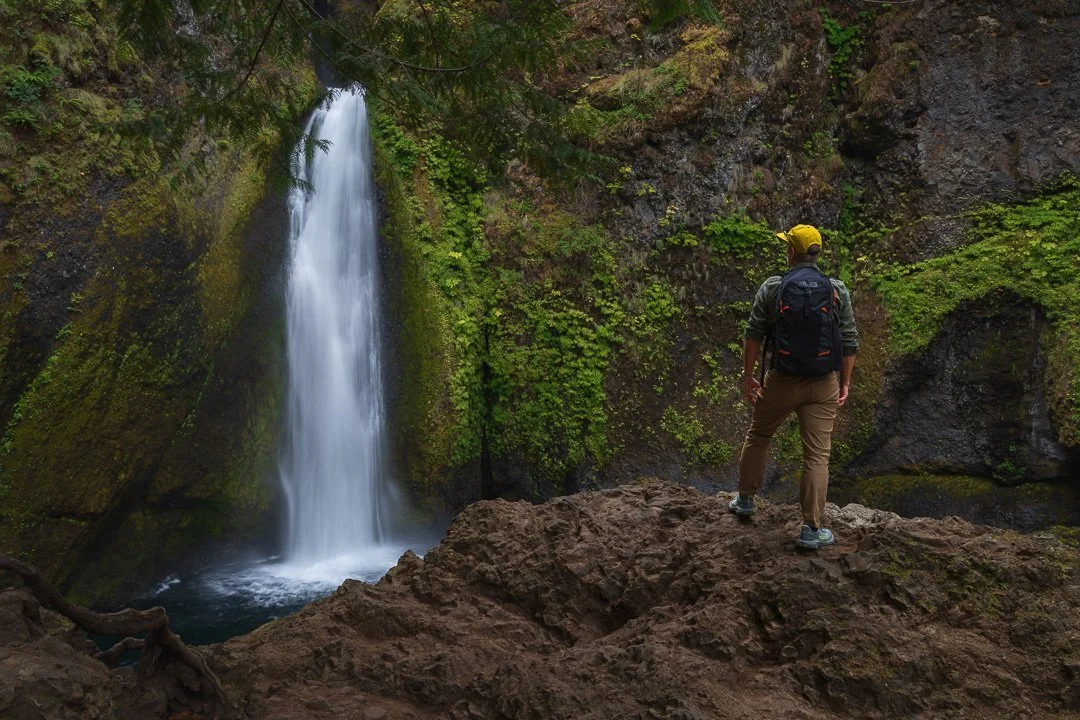
Self-portrait standing on a rock wearing the Cotton Carrier Hyker 25L backpack, enjoying the stunning view of Wahclella Falls and lush green canyon walls after a scenic hike in the Columbia River Gorge.
Fit, Comfort and Trail Performance
My number one requirement for any backpack is comfort. If I can’t wear it all day without eating ibuprofen like Skittles, I’m not interested. Unfortunately, there really isn’t a way to predict how a pack will perform on the trail after hours of hiking. You’ve just got to load it up, strap it on and put boots to dirt. I wore the Hyker 25L while waterfall hunting in the Columbia River Gorge, exploring in the Tetons and Zion, and all over the red rock desert here in Moab. I cannot overstate how comfortable this pack is to wear, even for extended periods of time while moving over rough terrain or standing in one spot behind a tripod, waiting for the magic to happen. It just…disappears. The harness is adjustable to fit a wide range of torso lengths. I was able to easily dial in a perfect fit, with the hip belt landing exactly where it is supposed to be to transfer pack weight to the hips. The shoulder straps cinch nice and tight and the sternum strap pulls them into a perfect position. Load lifters allow you to further customize fit, and they also work exactly as they should. Not once did my back hurt while wearing this pack, something I can’t say about my previous two backpacks. I broke my back in two places in a car crash in 2007 and coughing wrong can cause my back to ache all day, so finding a pack that I can wear all day with zero pain is pretty close to a miracle.
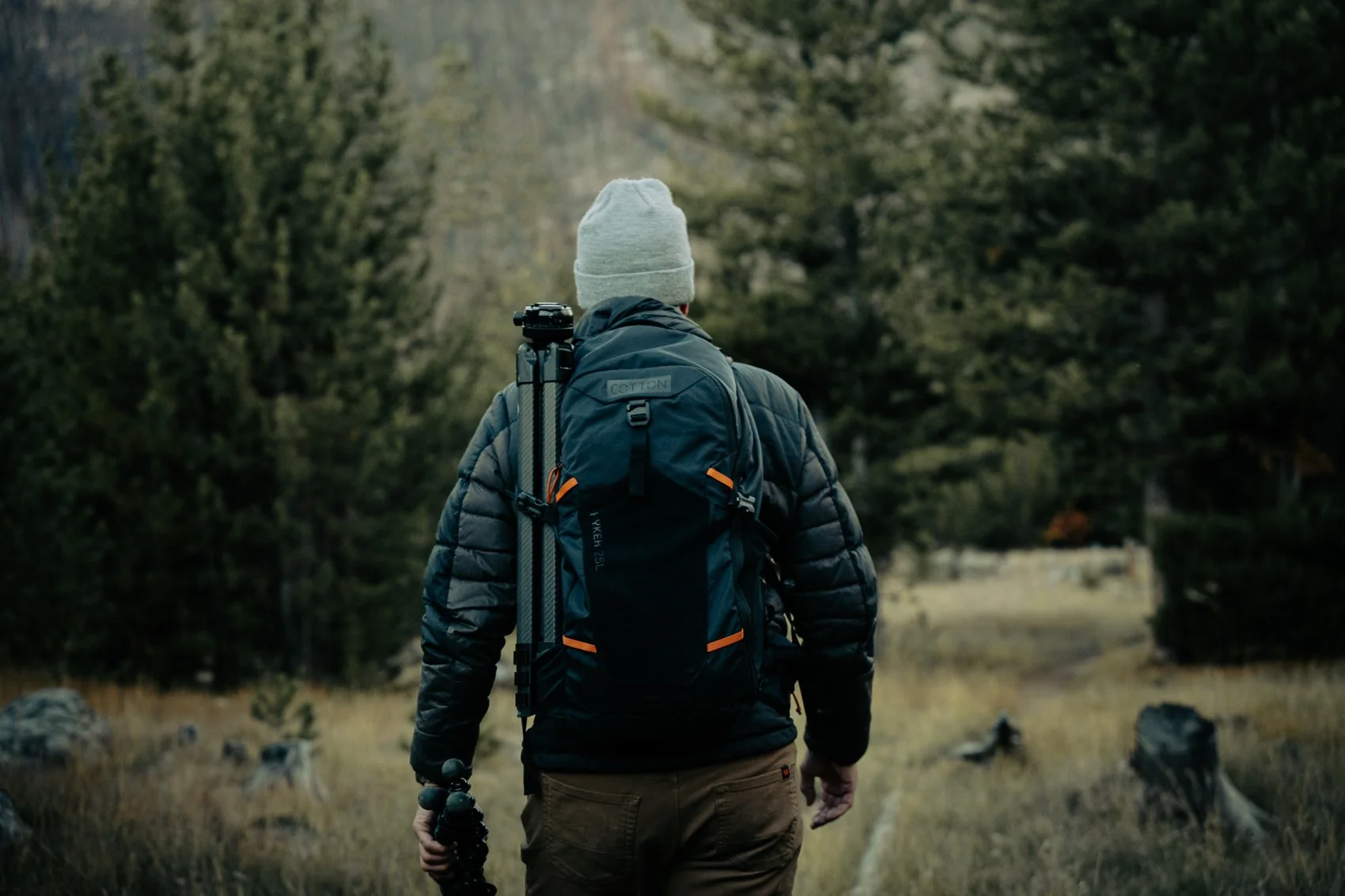
Bret Edge carrying camera gear in the Cotton Carrier Hyker 25L backpack with a tripod strapped to the side while exploring the trails around Green River Lakes, Wyoming. Photo by Jackson Edge, www.edgefrms.com.
Storage Capacity, Layout and Features
The Hyker 25L utilizes a unique way to access your gear that is safely contained inside the pack in the padded camera cube: a zipper runs almost all the way around the perimeter of the pack, allowing you to splay the pack open to expose the cube. This works well although I do prefer the more popular back panel access widely used by so many camera packs. There’s a pocket on each side of the pack and I used the one opposite the zipper to carry my tripod (Peak Design Pro Tall) by slipping two legs into the pocket and using the compression strap to hold the tripod tight against the pack. This worked well, and even when scrambling over steep terrain the tripod never budged. The downside? The compression strap puts tension on the zipper, making it difficult to zip/unzip when the tripod is secured to the pack. Loosening the strap before using the zipper resolves this issue.
The main pack body feels larger than 25 liters, in a good way. All of my previous packs have been 35 liters or larger, and I was a little concerned that 25L would be too small. It wasn’t. Even with the size large camera cube inside, I could fit a soft shell, a rain jacket and a large Ziploc full of snacks (I like to have options on the trail!). There’s a dedicated pocket for a water bladder and the hose exit port is centered at the top of the pack, allowing the wearer to choose whether the hose is routed over the left or right shoulder. Unfortunately, there isn’t a clip or elastic strap on either shoulder strap to hold the hose in place. This is probably my biggest complaint about the pack as it seems like a design flaw that could have been easily addressed. A small zipper pocket on the right hip belt is a great spot to stash car keys, lip balm or, you guessed it…a snack. On the left side of the hip belt you’ll find the “landing pad”, a system that allows you to easily and securely mount Cotton Carrier accessories like lens bags or their camera holster. While we’re talking about the hip belt - the straps are long. Like, really long. Granted, I’m not a big guy but when I tighten the hip belt the straps hang down to my knees. I also wish the hip belt straps used a forward-pull design instead of pulling the straps outward, away from the buckle. It’s a minor gripe but I find it much easier to tighten hip belts that use a forward-pull design.
The Hyker 25L has a shove-it pocket on the back, something I consider almost mandatory. I was able to fit a heavy down jacket into the pocket, something you’d never guess you could do by looking at it because the pocket sits nearly flush with the pack and looks pretty small. A zipper pocket on the outside of the pack is large enough for a beanie, gloves and several smaller items like a headlamp and snacks. An elastic water bottle pocket on the zipper side of the pack is large enough for big water bottles and the design allows you to retrieve the bottle on the move, without stopping to dig it out. Putting it back into the pocket isn’t as easy, but with practice I was able to do it.
The left shoulder strap has an elastic pouch that fits a small water bottle or phone and snaps closed when not in use. On the right shoulder strap you’ll find Cotton Carrier’s “twist and lock receiver” that allows you to mount your camera to the shoulder strap using the included aluminum “hub”. I didn’t use the shoulder strap mount because I keep a QR tripod plate on the bottom of my camera, which is incompatible with Cotton Carrier’s twist and lock receiver. They do make a Universal Tripod Adapter Plate that has a built in hub. It would have allowed me to carry the camera on the shoulder strap and still use my tripod, but I didn’t have one for the review. Instead, I carried my camera in an Osprey chest pack which worked well with the Hyker 25L pack. A rain cover stows out of the way in a zipper pocket at the bottom of the pack, but can be quickly deployed when needed.
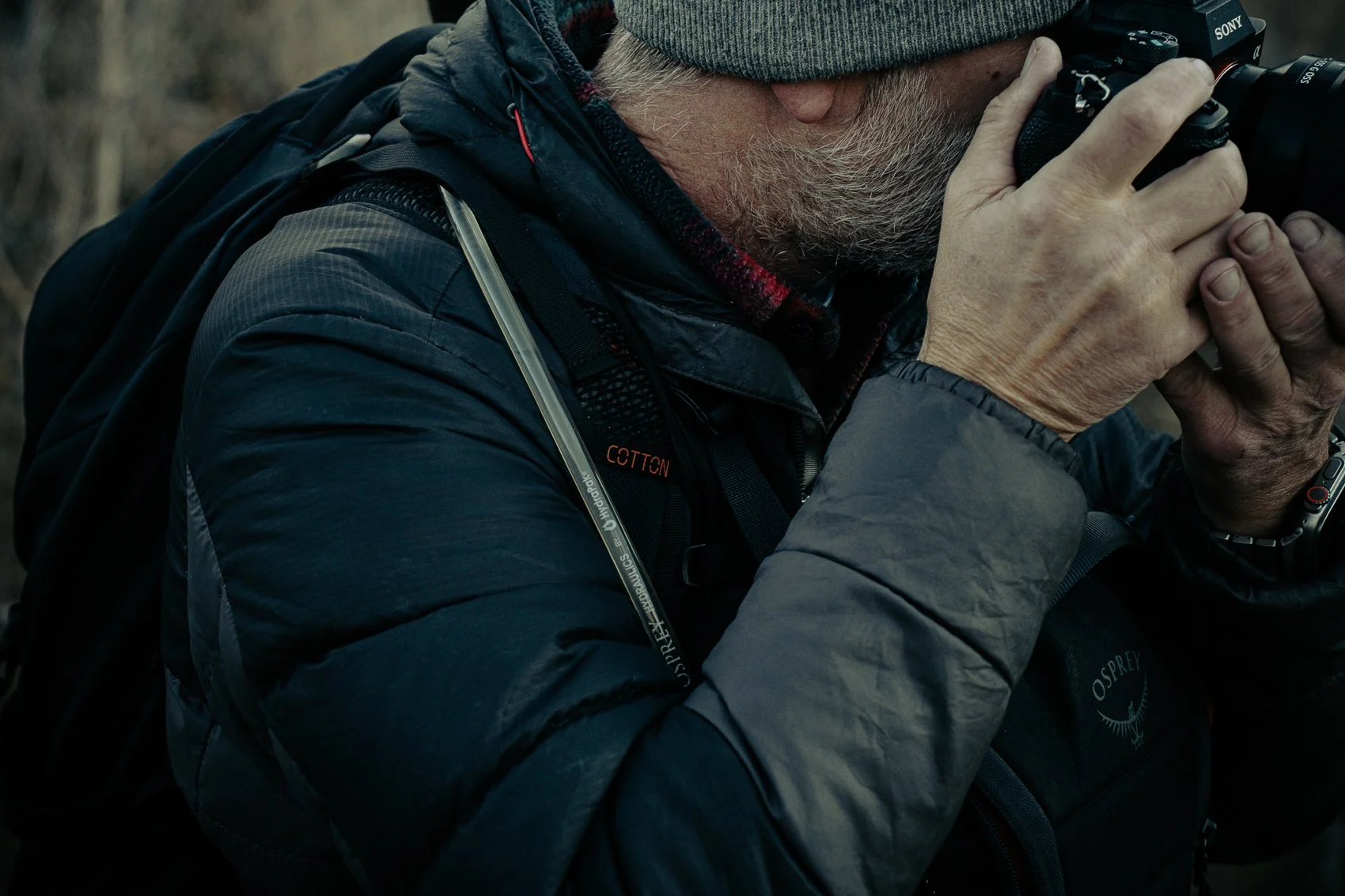
Close up photo of the Cotton Carrier Hyker 25L showing the logo on the shoulder strap, shot on location at Green River Lakes in the Wind River Mountains of Wyoming . Photo by Jackson Edge, www.edgefrms.com.
Durability, Build and Gear Layout
Despite being set down in mud in Oregon, frosty grass in the Tetons, and rough slickrock in Zion and Moab, the pack fabric is holding up well. I haven’t found any signs of damage; no snags, tears or abrasions. The camera cube is lightly padded with adjustable dividers. I carried a 14-24 and 28-200 lens, filters, an extra battery and a few other small accessories and had room to spare. I could have easily fit my Sony A7IV and 24-105 lens inside, along with one of the aforementioned lenses, had I not carried the camera in a chest pack.
Value and Final Verdict
At $269 for the pack and $75 for the large camera cube, the Hyker 25L is competitively priced when compared to similar packs by Shimoda, f-stop gear, Lowepro and others. I own packs by all those brands (and a few more), and the Hyker 25L has sent them all to the garage, where they will gather dust since the Cotton Carrier has become my go-to pack.
One final note: the Hyker 25L is perfect for camera kits that don’t include a long lens. Over the summer I bought the Sony FE 400-800mm f/6.3-8 G OSS. It is an absolute beast. I am able to carry it in the Hyker 25L, but I have to remove the camera cube and carry the 400-800, 14-24 and 28-200 in indvidual lens pouches inside the pack. This is less than ideal. That’s not a knock on the pack as it wasn’t designed to carry big lenses. Even so, with all that weight, it was still extremely comfortable. I’ve already shared this with Cotton Carrier, but I REALLY hope they produce a larger pack in the Hyker line-up, something in the 35-40L range with an extra large camera cube. When they do, I’ll be first in line to claim one.
Any questions about the pack? Leave a comment and I’ll get right back to you!
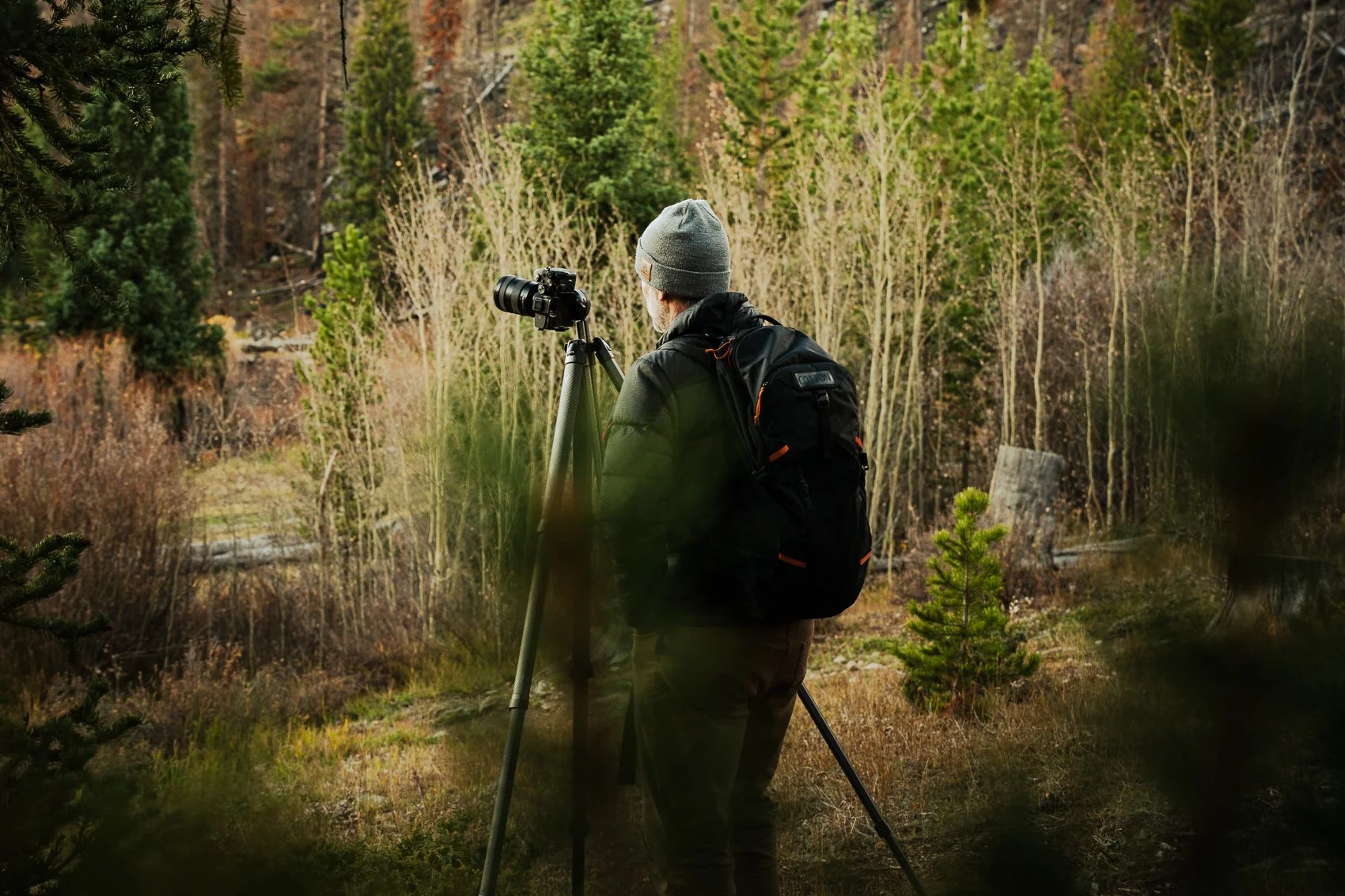
Setting up a tripod shot in the woods near Green River Lakes with the Cotton Carrier Hyker 25L backpack comfortably on during a sunrise photography session. Photo by Jackson Edge, www.edgefrms.com.