
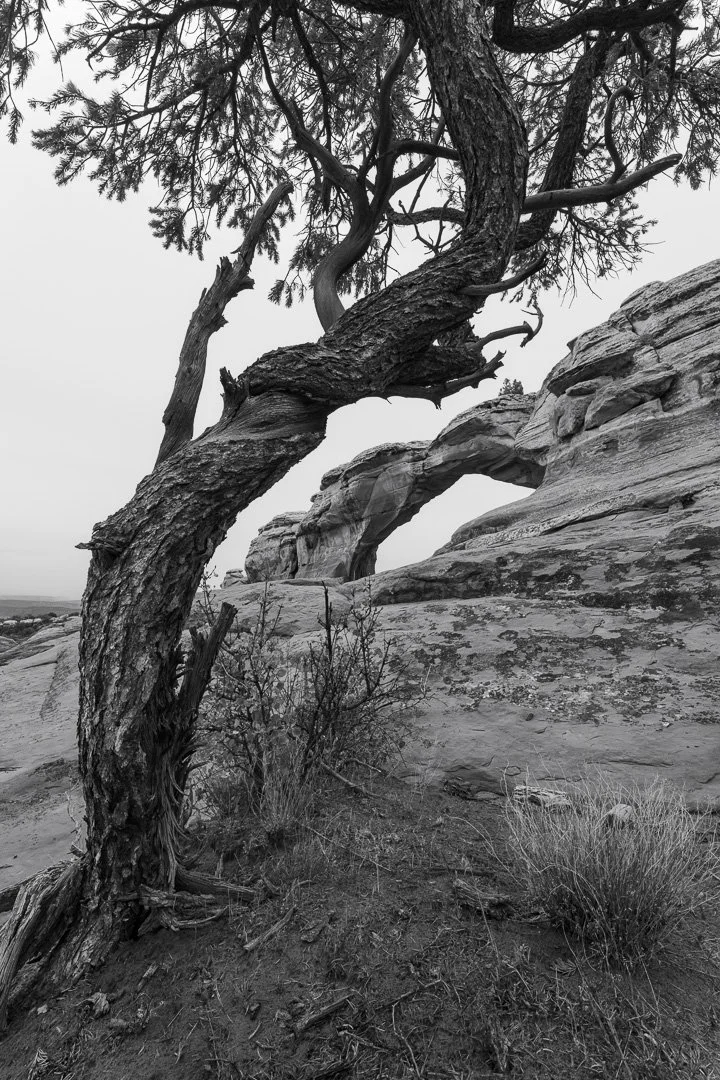
When photographing iconic locations like Arches National Park, it’s easy to settle for standard grand-landscape views. However, true visual storytelling often happens when we step out of that comfort zone and look for more intimate compositions—these deliberate decisions transform a good photograph into an intentional piece of art.
During a recent outing to Broken Arch, a flat, dull overcast sky presented a common field challenge. Rather than walking away or hoping for light that wasn't going to materialize, the key was using composition to solve the environmental limitations.
Here is how this image came together step by step:
1. Finding Repeating Forms in Nature
Great compositions often rely on rhythm and harmony. While exploring the area, I noticed a gnarled pinyon pine whose sweeping trunk closely mirrored the natural curve of Broken Arch. By pairing the organic bend of the tree with the weathered sandstone curve behind it, the image creates a visual dialogue between the foreground and background.
2. Avoiding Edge Merges & Maintaining Visual Balance
One of the most critical aspects of field technique is managing visual separation. Merging lines—where a foreground object touches or overlaps an essential background element—creates visual friction that distracts the viewer’s eye.
To keep the composition clean:
I needed the tree and the sandstone fin/arch to interact harmoniously without overlapping.
I spent considerable time adjusting my tripod position, moving it literally inch by inch.
Lowering, raising, and shifting the camera angle allowed the pine’s trunk to outline the backdrop while giving the arch room to breath cleanly in its own space.
3. Solving Flat Skies with Natural Elements
An overcast sky can leave large, empty dead-zones at the top of a frame. To solve this, I positioned the crown of the pinyon pine near the upper frame line. The intricate web of branches and needles filled the dull sky with texture and interest, converting a lighting flaw into a strong compositional asset.
Field Takeaway for Landscape Photographers
Before locking down your tripod, always ask yourself: Is every element in this frame serving a purpose? Slow down, micro-adjust your camera position, and pay close attention to where your foreground and background elements meet.
Interested in mastering field composition, reading light and adapting to conditions on location? Join us on a private Moab Photo Workshop to learn these techniques firsthand in the red rock country of Utah!