
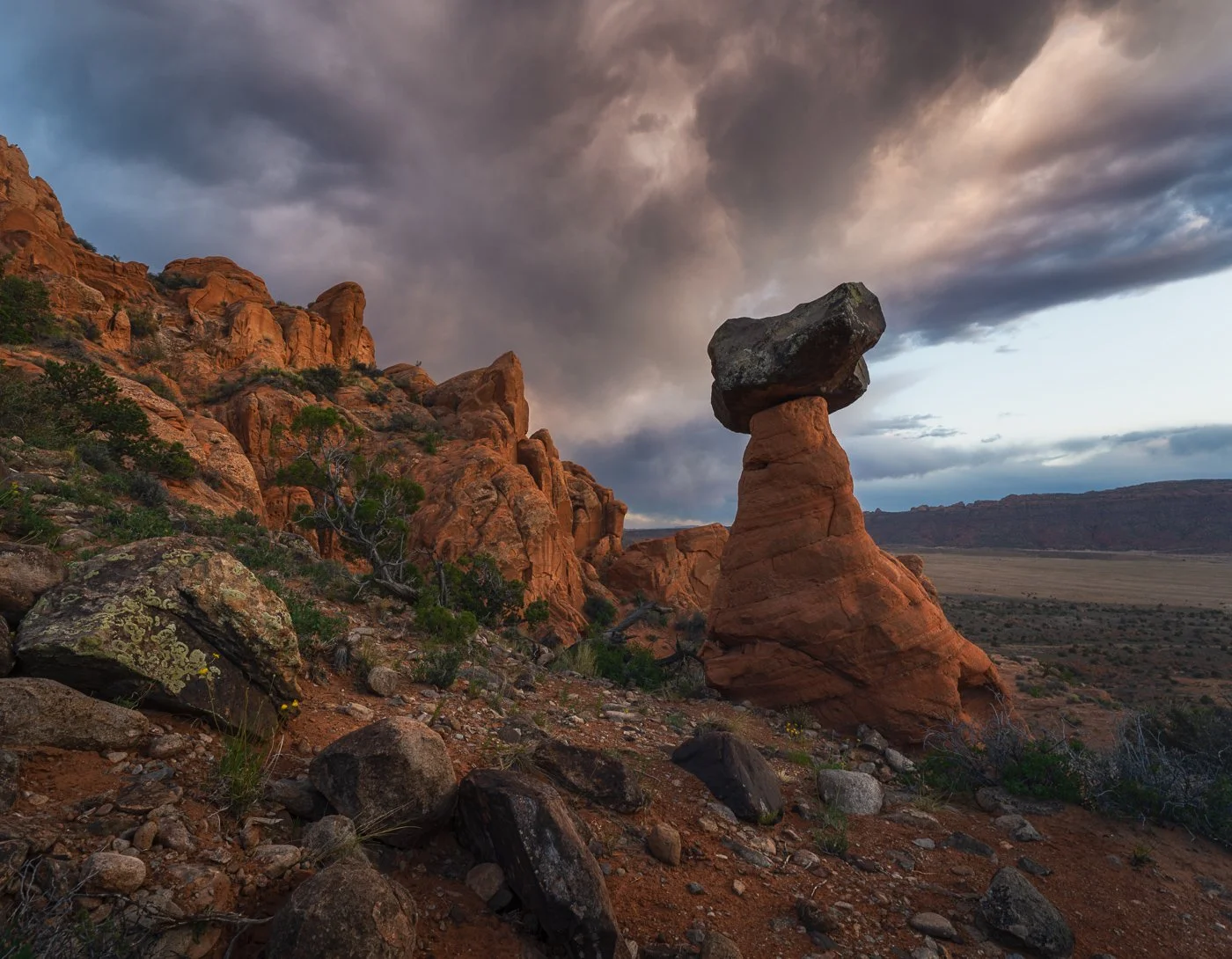
When most people think of summer in Moab, they think of the blazing sun, oppressive heat and long days in the Colorado River. But for landscape photographers, summer is one of the most dynamic, thrilling, and rewarding times of the year to explore the Red Rock Country.
If you are willing to brave the heat and watch the weather reports, summer rewards you with two spectacular phenomena: dramatic afternoon monsoon storms and pristine night skies.
Here is our ultimate guide to photographing Moab during the summer months, along with the essential tips and safety precautions you need to know.

This perspective from the canyon rim emphasizes the scale of the Moab region. A lone juniper tree serves as a foreground anchor, its gnarled form contrasting with the sweeping, intricate layers of the gooseneck in the distance. The sunset light breaks through the heavy monsoon-season storm clouds, revealing the rich textures and deep reds of the Colorado Plateau and highlighting the winding river.
1. The Magic of Monsoon Season
Usually starting in late June and lasting through August, sometimes even into early September, the Southwest monsoon season kicks into high gear. While empty blue skies can work perfectly fine in Arches National Park—where you can compose shots with majestic sandstone towers and arches protruding into the deep blue—they fall flat at places like Dead Horse Point and Canyonlands National Park.
Dead Horse Point and Canyonlands offer vast, sweeping vistas looking down into massive canyons. Without dramatic clouds, these wide-open views tend to lose much of their visual appeal. Monsoon season changes everything. Massive thunderheads, sweeping curtains of rain, and localized storms provide the scale, contrast, and drama these epic vistas demand.
Pro Tip: Plan to be on-site and ready to shoot right at the leading and trailing edges of storms. This is when you will catch the most dramatic skies and that fleeting, ethereal storm light that often make the difference between a good image, and a great one. If dark clouds and virga (rain that evaporates before hitting the ground) are present, change your composition to include more sky than usual. The sky becomes just as vital to the scene as the landscape itself.
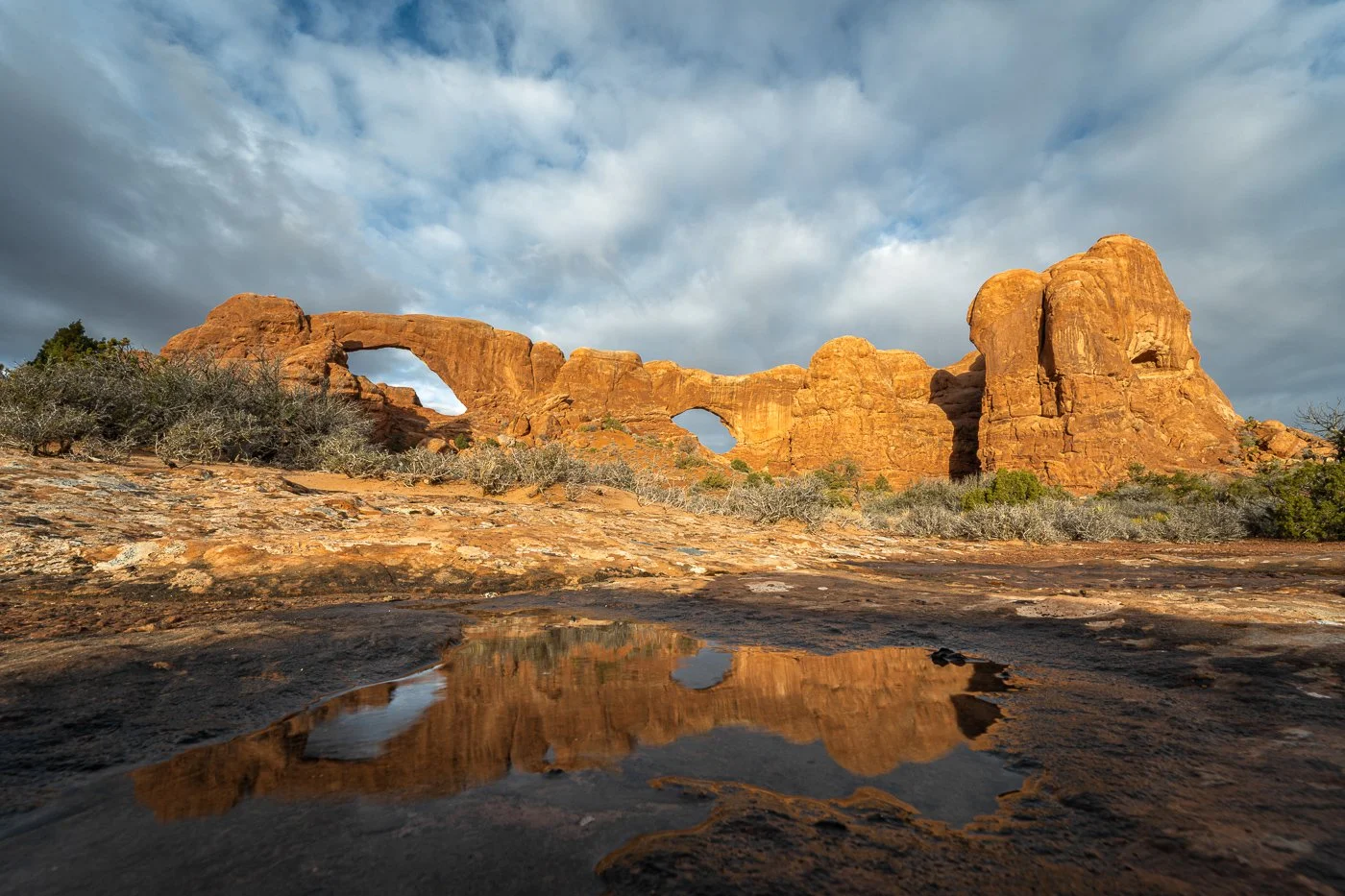
Utilizing a wide-angle lens allows you to capture the dual beauty of Arches National Park after a summer storm. By dropping the camera low to a water-filled sandstone pothole, the iconic North and South Windows (known as "The Spectacles") are mirrored in the reflection, balancing the glowing sunrise light with the dramatic, clearing clouds above.
2. After the Storm: Reflections and Waterfalls
Monsoon storms in Moab usually form in the afternoon. They are typically short-lived but incredibly intense. When the downpour stops, the desert transforms.
Keep an eye out for ephemeral waterfalls cascading directly off the sheer sandstone cliffs—a rare and breathtaking sight. Take a drive down Kane Creek Road or Highway 128 and you’ll see dozens of muddy reddish-brown falls pouring off the cliffs. Normally dry washes become powerful rivers, adding striking visual interest to your photographs. You may want to use a polarizing filter to reduce reflections off of wet rock and lengthen your shutter speed if you want to record the falls as a silky smooth ribbon of water. I’ve been using the Breakthrough Filters polarizer for years and it’s never let me down. Additionally, the rain fills the natural sandstone basin "potholes" carved into the rock. These temporary puddles create perfect, mirror-like surfaces.
Pro Tip: Pack your wide-angle lens. Get low to a water-filled pothole and use it to catch the reflections of the surrounding red cliffs, distant arches, and clearing storm clouds. These low, wide-angle perspectives can make a small pothole appear much larger in your image. My go to lens for these compositions? The Sigma 14-24mm f/2.8. You may need to use a technique called focus stacking to maintain sharpness from foreground to background. New Zealand photographer William Patino has a short, to-the-point focus stacking tutorial on YouTube that is a perfect introduction to this technique. Though it is possible to focus stack images from a handheld shot it’s much easier to do so when working from a tripod. I’ve been using the Peak Design Pro Tripod Tall for almost a year and though it isn’t cheap, it’s built like a tank and offers a lot of flexibility for creating low-angle compositions.
3. Summer Nights: Prime Astrophotography
Once the afternoon storms clear out, summer offers the absolute best conditions of the year for astrophotography. The core of the Milky Way is high and bright in the night sky, and Moab’s designated Dark Sky Parks (including Arches, Canyonlands, and Dead Horse Point) offer some of the lowest light pollution in the country. Combining the dark skies with iconic silhouettes like Balanced Rock or Delicate Arch makes for an unforgettable night shoot. Just remember: the use of artificial light, generally called light painting, is illegal in both of Moab’s national parks.
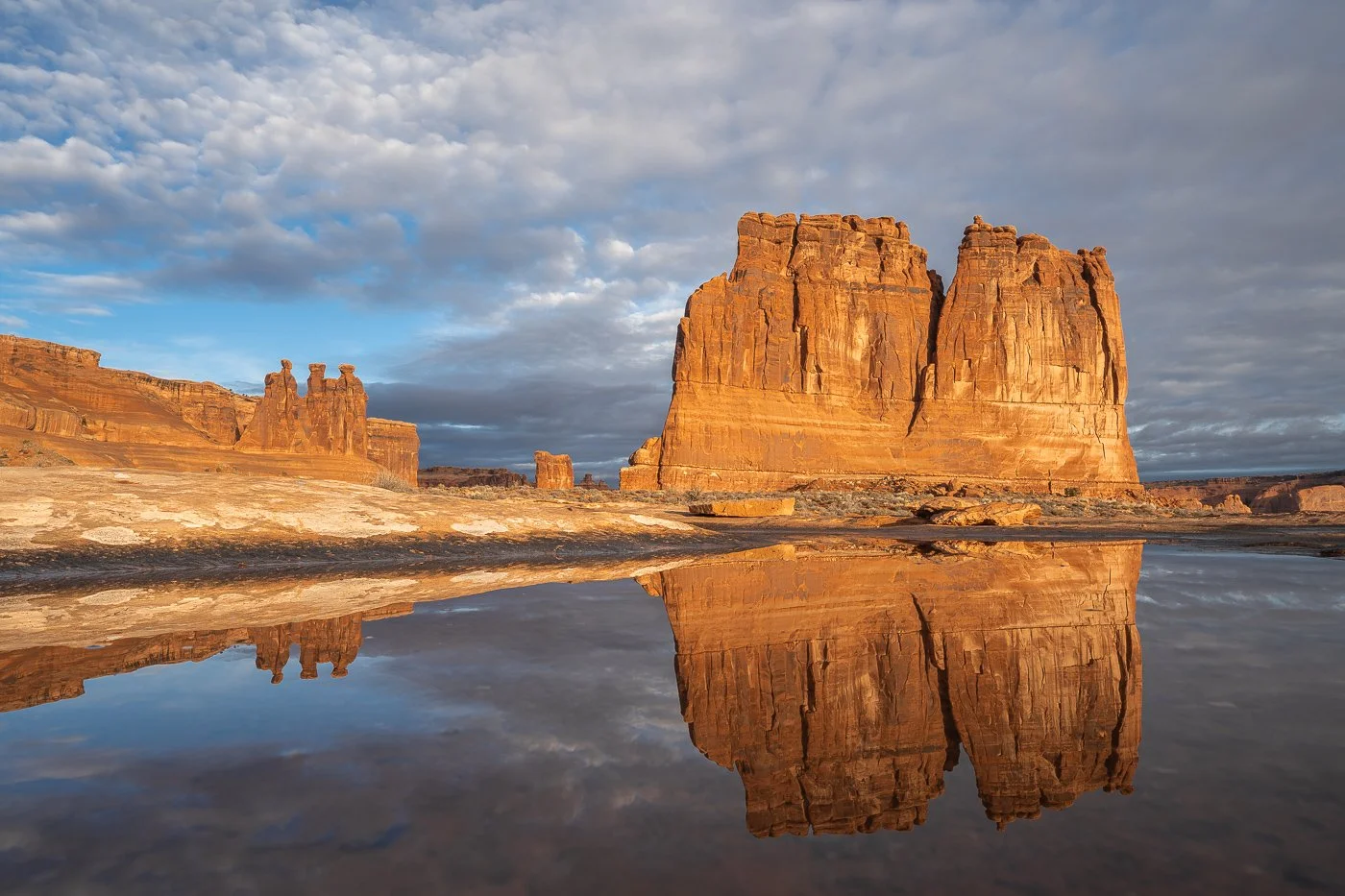
Capitalizing on the aftermath of a desert thunderstorm pays off beautifully in the Courthouse Towers viewpoint. By framing this sunrise shot using a wide-angle lens right at ground level, a temporary sandstone pothole puddle creates a stunning, symmetry-filled mirror reflection of The Organ and the Three Gossips glowing in the morning light.
4. Smart Summer Scouting
With daytime temperatures frequently soaring past 100°F (38°C), you need to manage your time wisely.
Morning/Evening: Dedicate your golden hours and blue hours to shooting.
Midday: Use the middle of the day to scout locations using maps, apps, and by driving through the parks in the comfort of your air conditioned vehicle. While it’s generally too hot for long hikes, short walks to overlooks are doable and will give you an opportunity to note potential photographic opportunities when the light is right. For more details on what to look for when scouting locations, here’s a link to my recent post, “The Art of the Scout: Why Location Scouting is a Landscape Photographer’s Greatest Tool”.
5. Critical Summer Precautions
While summer photography in Moab is unmatched, the desert can be unforgiving. Safety should always be your top priority.
Hydration: The desert air is incredibly dry. Drink significantly more water than you think you need, and always keep a cooler with extra water and snacks in your vehicle. It’s just as important to maintain your electrolytes as it is to stay hydrated!
Flash Floods: A storm miles away can send a wall of water tearing through a slot canyon or wash in seconds. Never enter canyons or low-lying washes if rain is in the forecast.
Lightning: Monsoon storms produce frequent, dangerous lightning. Because you will often be shooting on high, exposed canyon rims (like Dead Horse Point), you are a prime target. If you hear thunder, seek shelter in your vehicle immediately.
Final Thoughts
Summer in Moab isn't just about surviving the heat—it’s about chasing the drama. By tracking the monsoons, mastering the wide-angle reflection, and staying up for the Milky Way, you’ll walk away with images that most visitors never get the chance to see.
Want to learn how to safely chase storms and capture the perfect Milky Way composition? Learn more about our private photography workshops or pick up our eFotoGuides to ensure you’re at the right places, in the best light, at the right time.
Ok, so…you came to Moab and were lucky enough to make a few amazing images of dramatic landscapes under dark, ominous skies. Don’t just leave them in Lightroom or post them to social media; print them! When creating your own photography prints there are really only two printers to consider: Epson and Canon. They both produce stunning prints and each one has unique pros and cons.You truly can’t go wrong. That said, I opted for the Canon imagePROGRAF Pro-310. I chose this printer for two primary reasons; it’s cheaper to operate than the equivalent Epson and the printhead is less likely to clog during irregular use. I’ve been using it for a few months and have produce around fifty prints, at various sizes, without issue.