

Summer in Moab: Chasing Monsoons, Dramatic Skies, and Milky Way Magic
Think summer in Moab is just about surviving the heat? Think again. From dramatic afternoon monsoon storms that trigger ephemeral waterfalls and perfect pothole reflections to pristine dark skies built for Milky Way astrophotography, summer is secretly one of the most rewarding seasons for landscape photographers. Discover our top composition tips, favorite hidden viewpoints, and essential desert safety guide to capturing Moab’s most dynamic season.
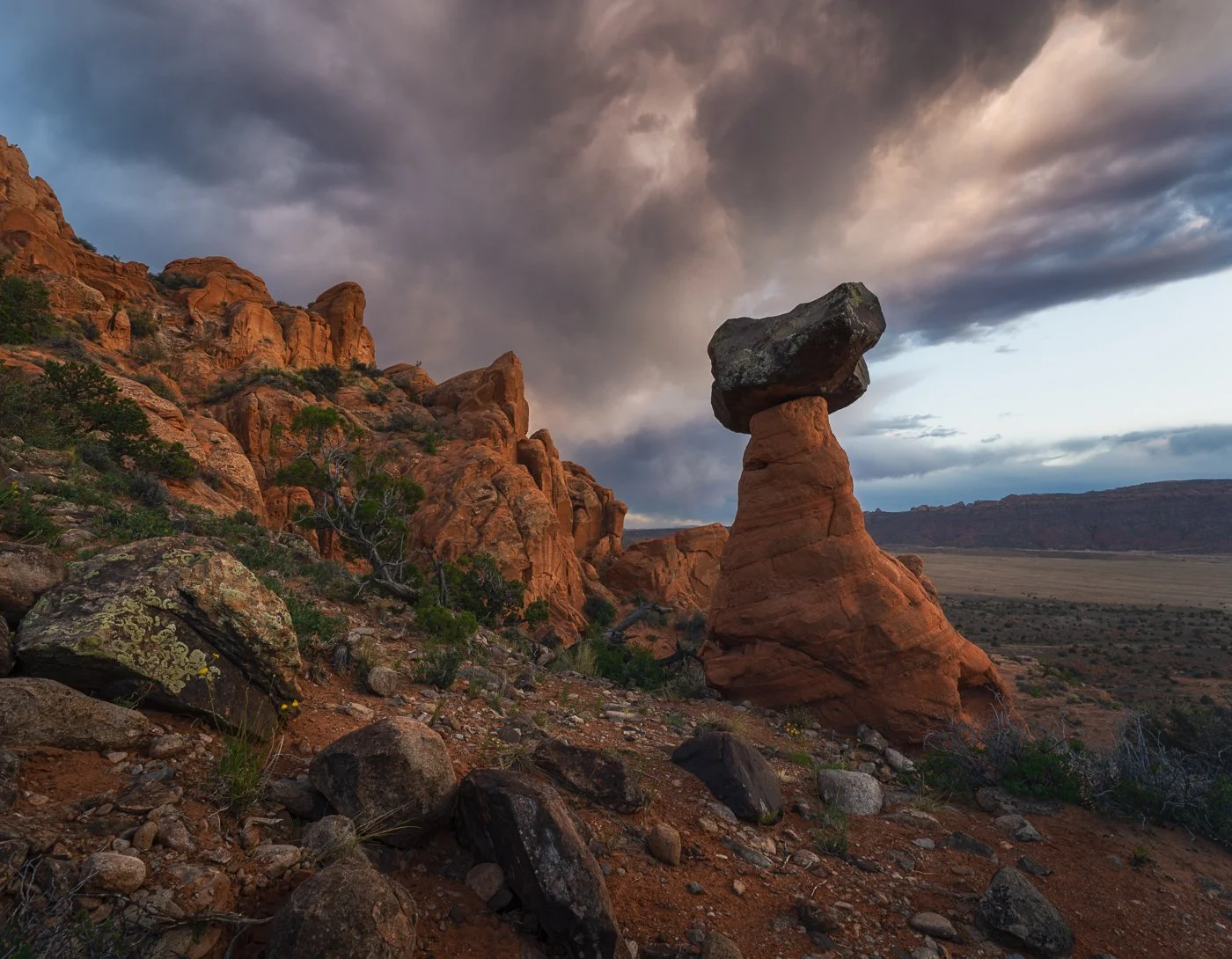
This is exactly the kind of magic you can capture when you chase summer monsoons in Moab. As a powerful afternoon thunderstorm begins to break up, the trailing edge of the storm catches the warm golden hour light, casting a dramatic glow over this towering red rock hoodoo and the sweeping desert valley below.
When most people think of summer in Moab, they think of the blazing sun, oppressive heat and long days in the Colorado River. But for landscape photographers, summer is one of the most dynamic, thrilling, and rewarding times of the year to explore the Red Rock Country.
If you are willing to brave the heat and watch the weather reports, summer rewards you with two spectacular phenomena: dramatic afternoon monsoon storms and pristine night skies.
Here is our ultimate guide to photographing Moab during the summer months, along with the essential tips and safety precautions you need to know.

This perspective from the canyon rim emphasizes the scale of the Moab region. A lone juniper tree serves as a foreground anchor, its gnarled form contrasting with the sweeping, intricate layers of the gooseneck in the distance. The sunset light breaks through the heavy monsoon-season storm clouds, revealing the rich textures and deep reds of the Colorado Plateau and highlighting the winding river.
1. The Magic of Monsoon Season
Usually starting in late June and lasting through August, sometimes even into early September, the Southwest monsoon season kicks into high gear. While empty blue skies can work perfectly fine in Arches National Park—where you can compose shots with majestic sandstone towers and arches protruding into the deep blue—they fall flat at places like Dead Horse Point and Canyonlands National Park.
Dead Horse Point and Canyonlands offer vast, sweeping vistas looking down into massive canyons. Without dramatic clouds, these wide-open views tend to lose much of their visual appeal. Monsoon season changes everything. Massive thunderheads, sweeping curtains of rain, and localized storms provide the scale, contrast, and drama these epic vistas demand.
Pro Tip: Plan to be on-site and ready to shoot right at the leading and trailing edges of storms. This is when you will catch the most dramatic skies and that fleeting, ethereal storm light that often make the difference between a good image, and a great one. If dark clouds and virga (rain that evaporates before hitting the ground) are present, change your composition to include more sky than usual. The sky becomes just as vital to the scene as the landscape itself.
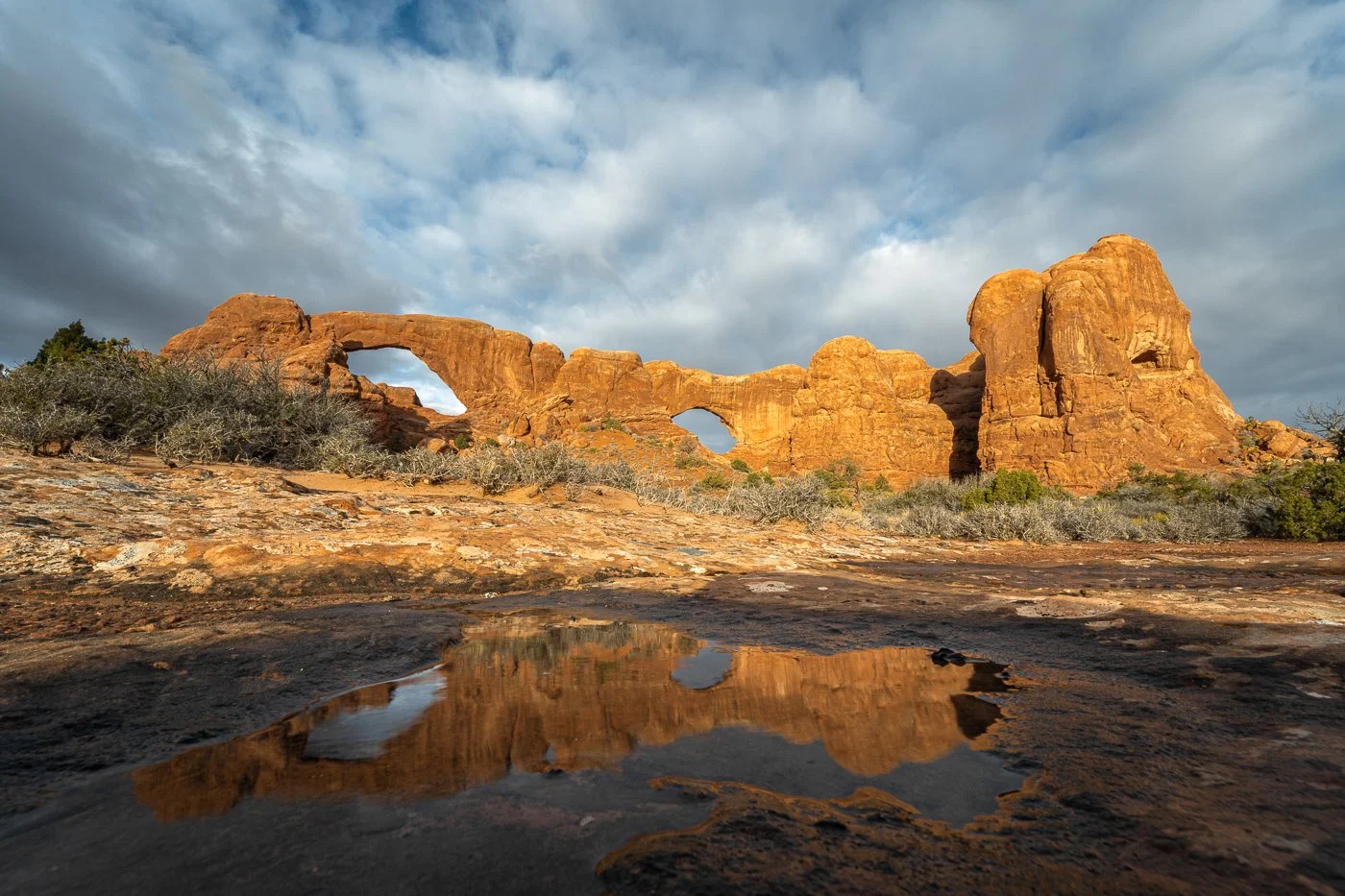
Utilizing a wide-angle lens allows you to capture the dual beauty of Arches National Park after a summer storm. By dropping the camera low to a water-filled sandstone pothole, the iconic North and South Windows (known as "The Spectacles") are mirrored in the reflection, balancing the glowing sunrise light with the dramatic, clearing clouds above.
2. After the Storm: Reflections and Waterfalls
Monsoon storms in Moab usually form in the afternoon. They are typically short-lived but incredibly intense. When the downpour stops, the desert transforms.
Keep an eye out for ephemeral waterfalls cascading directly off the sheer sandstone cliffs—a rare and breathtaking sight. Take a drive down Kane Creek Road or Highway 128 and you’ll see dozens of muddy reddish-brown falls pouring off the cliffs. Normally dry washes become powerful rivers, adding striking visual interest to your photographs. You may want to use a polarizing filter to reduce reflections off of wet rock and lengthen your shutter speed if you want to record the falls as a silky smooth ribbon of water. I’ve been using the Breakthrough Filters polarizer for years and it’s never let me down. Additionally, the rain fills the natural sandstone basin "potholes" carved into the rock. These temporary puddles create perfect, mirror-like surfaces.
Pro Tip: Pack your wide-angle lens. Get low to a water-filled pothole and use it to catch the reflections of the surrounding red cliffs, distant arches, and clearing storm clouds. These low, wide-angle perspectives can make a small pothole appear much larger in your image. My go to lens for these compositions? The Sigma 14-24mm f/2.8. You may need to use a technique called focus stacking to maintain sharpness from foreground to background. New Zealand photographer William Patino has a short, to-the-point focus stacking tutorial on YouTube that is a perfect introduction to this technique. Though it is possible to focus stack images from a handheld shot it’s much easier to do so when working from a tripod. I’ve been using the Peak Design Pro Tripod Tall for almost a year and though it isn’t cheap, it’s built like a tank and offers a lot of flexibility for creating low-angle compositions.
3. Summer Nights: Prime Astrophotography
Once the afternoon storms clear out, summer offers the absolute best conditions of the year for astrophotography. The core of the Milky Way is high and bright in the night sky, and Moab’s designated Dark Sky Parks (including Arches, Canyonlands, and Dead Horse Point) offer some of the lowest light pollution in the country. Combining the dark skies with iconic silhouettes like Balanced Rock or Delicate Arch makes for an unforgettable night shoot. Just remember: the use of artificial light, generally called light painting, is illegal in both of Moab’s national parks.
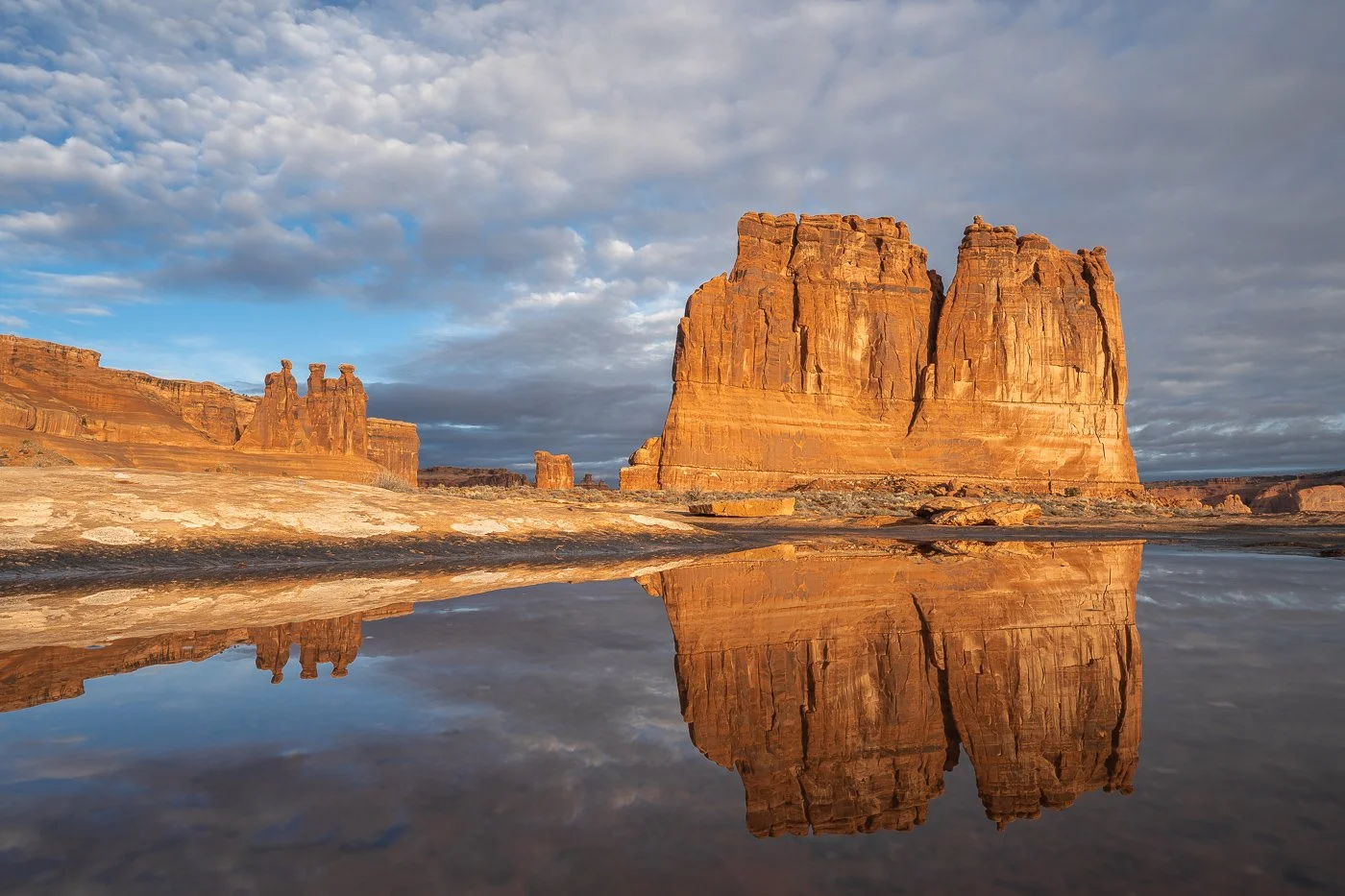
Capitalizing on the aftermath of a desert thunderstorm pays off beautifully in the Courthouse Towers viewpoint. By framing this sunrise shot using a wide-angle lens right at ground level, a temporary sandstone pothole puddle creates a stunning, symmetry-filled mirror reflection of The Organ and the Three Gossips glowing in the morning light.
4. Smart Summer Scouting
With daytime temperatures frequently soaring past 100°F (38°C), you need to manage your time wisely.
Morning/Evening: Dedicate your golden hours and blue hours to shooting.
Midday: Use the middle of the day to scout locations using maps, apps, and by driving through the parks in the comfort of your air conditioned vehicle. While it’s generally too hot for long hikes, short walks to overlooks are doable and will give you an opportunity to note potential photographic opportunities when the light is right. For more details on what to look for when scouting locations, here’s a link to my recent post, “The Art of the Scout: Why Location Scouting is a Landscape Photographer’s Greatest Tool”.
5. Critical Summer Precautions
While summer photography in Moab is unmatched, the desert can be unforgiving. Safety should always be your top priority.
Hydration: The desert air is incredibly dry. Drink significantly more water than you think you need, and always keep a cooler with extra water and snacks in your vehicle. It’s just as important to maintain your electrolytes as it is to stay hydrated!
Flash Floods: A storm miles away can send a wall of water tearing through a slot canyon or wash in seconds. Never enter canyons or low-lying washes if rain is in the forecast.
Lightning: Monsoon storms produce frequent, dangerous lightning. Because you will often be shooting on high, exposed canyon rims (like Dead Horse Point), you are a prime target. If you hear thunder, seek shelter in your vehicle immediately.
Final Thoughts
Summer in Moab isn't just about surviving the heat—it’s about chasing the drama. By tracking the monsoons, mastering the wide-angle reflection, and staying up for the Milky Way, you’ll walk away with images that most visitors never get the chance to see.
Want to learn how to safely chase storms and capture the perfect Milky Way composition? Learn more about our private photography workshops or pick up our eFotoGuides to ensure you’re at the right places, in the best light, at the right time.
Ok, so…you came to Moab and were lucky enough to make a few amazing images of dramatic landscapes under dark, ominous skies. Don’t just leave them in Lightroom or post them to social media; print them! When creating your own photography prints there are really only two printers to consider: Epson and Canon. They both produce stunning prints and each one has unique pros and cons.You truly can’t go wrong. That said, I opted for the Canon imagePROGRAF Pro-310. I chose this printer for two primary reasons; it’s cheaper to operate than the equivalent Epson and the printhead is less likely to clog during irregular use. I’ve been using it for a few months and have produce around fifty prints, at various sizes, without issue.
Moab Photography Conditions - May 19, 2019: SUPER BLOOM!
Moab landscape and adventure photographer Bret Edge shares an update on the 2019 wildflower super bloom at Arches National Park, Canyonlands National Park, Dead Horse Point State Park and the general Moab area.

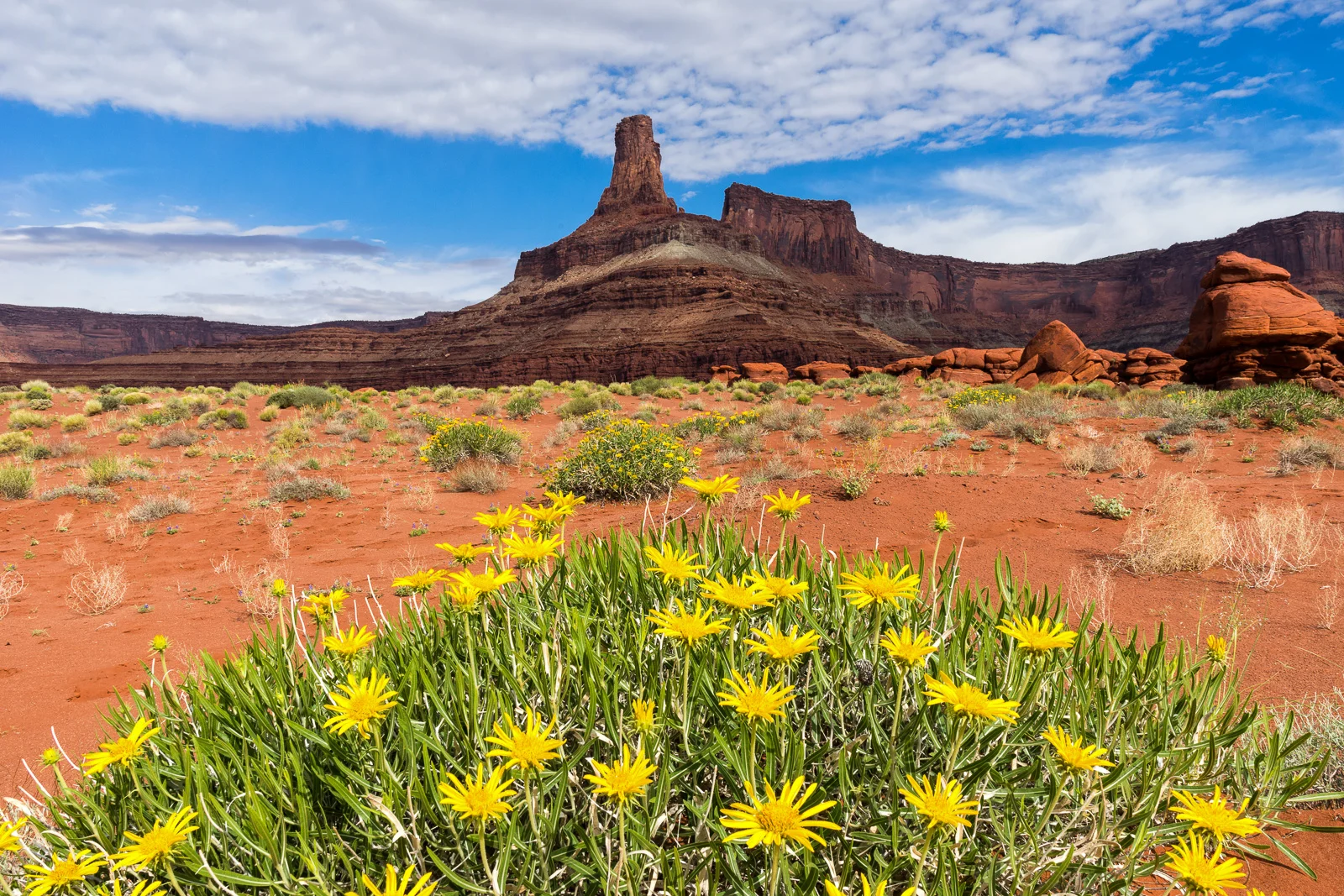
Wildflowers in Sand Dunes Below Chimney Rock - Moab, Utah
I’ve lived in Moab for thirteen years and have been visiting for twenty, and I’ve never seen wildflowers blooming as profusely as they are right now. The Moab super bloom is real, and it’s here NOW. Making it even more impressive are the incredible skies we’ve had lately. If the weather forecast is accurate, those skies are sticking around all week. And, temperatures are way below average (60’s - 70’s), so it’s perfect for camping, hiking and exploring.
Where to find the wildflowers? Literally everywhere. People are losing their minds over the sego lilies blooming in vast carpets in areas like North Klondike Bluffs and out at the Bar M trail complex. Cactus wildflowers can be found in various stages of bloom depending on elevation. Yesterday at Dead Horse Point State Park, the cactus flowers were just barely getting started, but the daisies are growing in big, thick clumps. The prince’s plume I’ve seen in several locations, including Arches NP, is super healthy and like the daisies…thick.
Some spots I recommend exploring outside the parks include Fisher Towers, Castle Valley, Onion Creek, Corona Arch and Potash Road all the way to Canyonlands National Park, the aforementioned North Klondike Bluffs and the Behind the Rocks Wilderness Area south of Moab. In Arches, you’re less likely to be surrounded by the hordes if you hike out to Klondike Bluffs, where you’ll find wildflowers blooming in sand dunes below the Marching Men. More information on photography in Arches NP can be found in eFotoGuide: The Ultimate Guide to Photographing Arches National Park.
The Colorado River and all the local creeks are running high, and there’s rain on the way over the next couple of days. The La Sal Mountains are still wearing a healthy heaping of snow, so any composition that includes them will be that much better.
Now the bad news: it’s crowded like I’ve never seen it. If you’re headed to any of the parks, you’ll find it challenging to get away from the crowds. Campgrounds are packed, the hotels are expensive and hour and a half waits at most of the local restaurants are the norm during peak times. Still, I’d point my truck to Moab if I were you.
To celebrate this incredible bloom, and to help you find some of the best spots in Arches NP to take advantage of the flowers, I’m offering a 20% discount on my popular ebook: eFotoGuide: The Ultimate Guide to Photographing Arches National Park. No goofy codes needed. Normally $15, it’s now $12 until Friday, May 24.
Get out here and burn through some memory cards…or film, for the luddites who might be reading this!
Moab Photography Conditions - March 3, 2019
Professional landscape and adventure photographer Bret Edge provides updated, real-time photography conditions in Moab, Utah as of March 3, 2019.

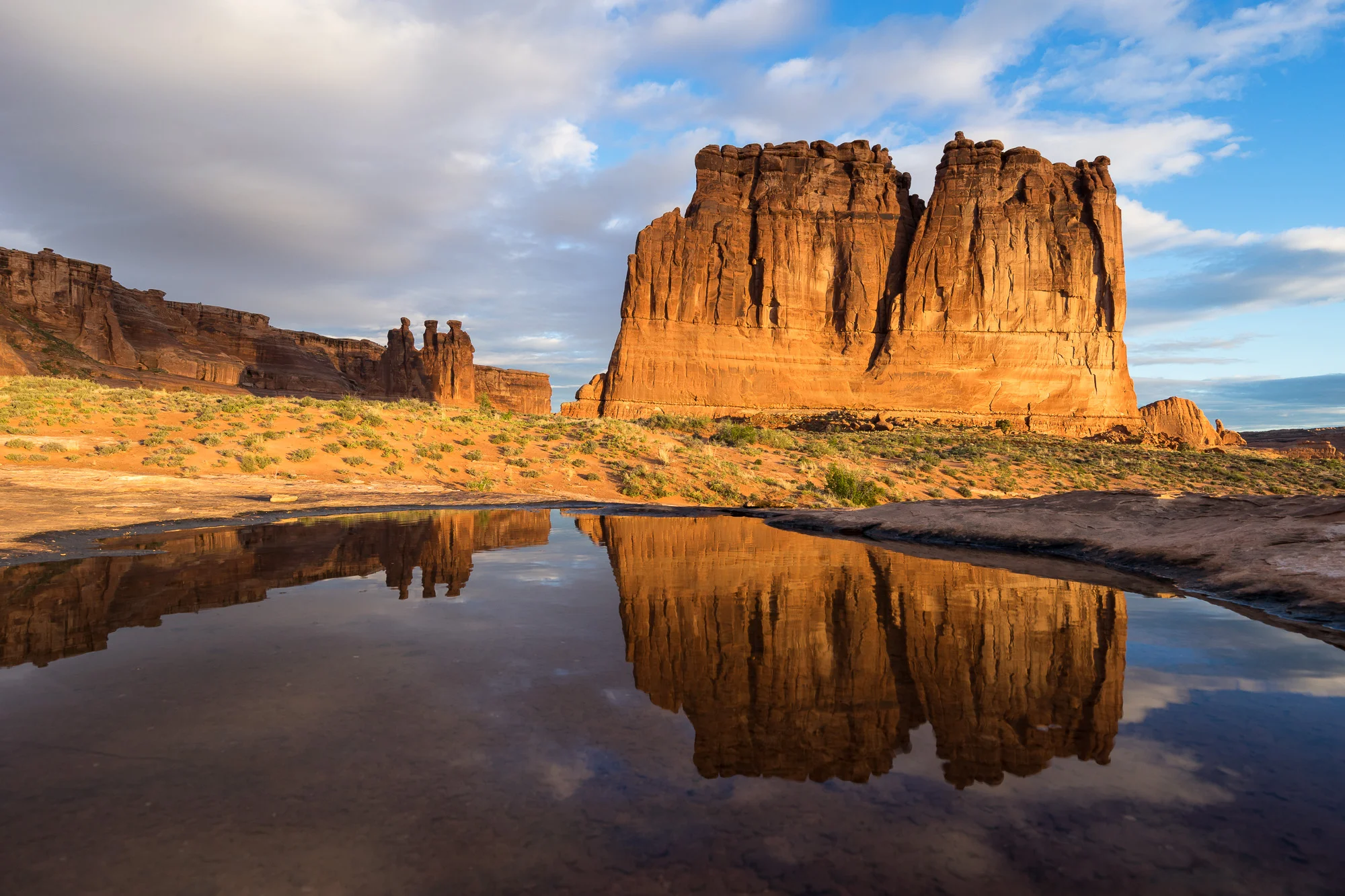
Courthouse Towers Reflecting in Pothole Below Clearing Storm, Arches National Park, Utah
The word of the day is “wet”. A couple weeks ago we had nearly a foot of snow fall in town, and yesterday it rained all day, melting whatever snow was remaining on the ground and filling washes, creeks and potholes to the brim. And, as the photographic icing, the sky is filled with interesting clouds with sunlight bursting through seams in the sky to illuminate the landscape below. To see that it’s a good time to be in Moab with a camera would be an understatement.
I expect the potholes will retain water for a few days given that the ground is so saturated from all the recent precipitation. The ten day forecast calls for warmer temperatures with days in the high 40’s to low 50’s and nights in the mid-30’s. Rain is possible on Wednesday and we may even experience some snow showers or frozen mix early next week. All ten days are predicted to be partly sunny…perfect for photography!
There is currently a road closure on Highway 128 about 1 mile east of Highway 191. A large rockfall is blocking the road and crews from the Utah Department of Transportation are working to clear it. The road is expected to re-open later this afternoon.
Where should you go to take advantage of all this water in the desert? Pick up a copy of eFotoGuide: The Ultimate Guide to Photographing Arches National Park to learn how, where and when to photograph over 20 of my favorite locations within the park. It’s only $15 and your purchase will help to support these valuable real-time photography condition updates as well as the other content I post on this blog.
Keep your eyes on this post as I’ll update it throughout the week as conditions and photographic opportunities change.
Moab Photography Conditions - February 19, 2019

Winter Evening at The Windows, Arches National Park
UPDATE, 2/23 @ 11:42 AM: It’s still snowing. The snow showers are coming and going, and each one hasn’t left more than a 1/4” of new snow on the ground but there is some additional accumulation. The parks are still open and photo conditions continue to improve. The forecast for tomorrow and Sunday are sunny and partly sunny, respectively. I predict that winter photography conditions in the Moab area will be at an all-time high this weekend. GET HERE NOW.
***************************************************
UPDATE, 2/22 @ 8:00 AM: Overnight we received some new snowfall amounting to no more than 1” accumulation. There is additional snow predicted today although it isn’t likely it will amount to much. Arches and Canyonlands National Parks are open. Both parks advise that the roads may be icy in areas.
****************************************************
UPDATE, 2/21 @ 4:30 PM: Moab is currently under a winter weather advisory and we are expected to receive 2-6” of new snow out of this storm. It’s snowing lightly now. I will update this post with current conditions and park access information tomorrow morning.
*****************************************************
UPDATE: Arches National Park is open as of around 3:00 PM today, Feb. 19. The latest update from Canyonlands - Island in the Sky indicates that the park road is still closed due to snow.
******************************************************
Snowmageddon has hit Moab. We received about 12” of snow in town from yesterday’s storm and we’ve got another 2-6” arriving tomorrow. Folks, this is right up there with the biggest storms to come through Moab in the thirteen years I’ve lived here. What does it all mean to photographers? Read on…
Conditions are generally top notch for landscape photography. Actually, I’d go so far as to say that these are some of the best winter photography conditions I’ve seen in Moab. There’s ample fresh snow on the ground, the sun is out and cotton ball clouds are floating through a brilliantly blue sky. In addition to the snow that is predicted to fall tomorrow, the ten day forecast is calling for very cold temperatures, which means this snow is going to be around for a while. That’s the good news.
The bad news is that Arches and Canyonlands National Parks are currently closed while crews work to clear the park roads. This is as of 1:00 PM today. Both parks are expected to open as soon as the roads have been plowed, though expect snowy and icy conditions on the roads and trails. I’ll do my best to update this post as information about roads, trails, parks and conditions becomes available to me. I also recommend that you check out the following social media accounts as you should expect updates from them as well. The Moab PD is really good about updating road conditions and closures in the Moab area.
Arches National Park on Twitter
Canyonlands National Park on Twitter
Moab City Police Department on Twitter
If you can’t access the parks, there are several locations worth photographing outside of the park boundaries. Highway 128 offers the Fisher Towers and Castle Valley, as well as several opportunities to photograph the Colorado River and unnamed sandstone features. Highway 128 is notorious for black ice and rockfall, so please use extreme caution. Corona Arch in this much snow will be a real treat. Kane Creek also has many opportunities to photograph the river as well as side canyons with lots of cottonwood trees that make interesting intimate landscapes. I wouldn’t recommend continuing on Kane Creek when the road transitions from pavement to dirt as there is significant exposure, no guardrails and it’ll be super slick.
For tips and other ideas on winter photography in Moab, be sure to check out this blog post: The Photographer’s Guide to Winter in Moab.
Last, but not least, I hope you’ll consider supporting me as I deliver these real time updates and other valuable information by purchasing one of my ebooks. They’re only $15/each and are loaded with high quality content to help you find and photograph the best locations in each park.
eFotoGuide: The Ultimate Guide to Photographing Arches National Park
eFotoGuide: The Ultimate Guide to Photographing Big Bend National Park
eFotoGuide: The Ultimate Guide to Photographing Zion National Park
Moab Photography Conditions - January 15, 2019
Moab nature and adventure photographer Bret Edge provides an update on current photography conditions in Moab, Utah.
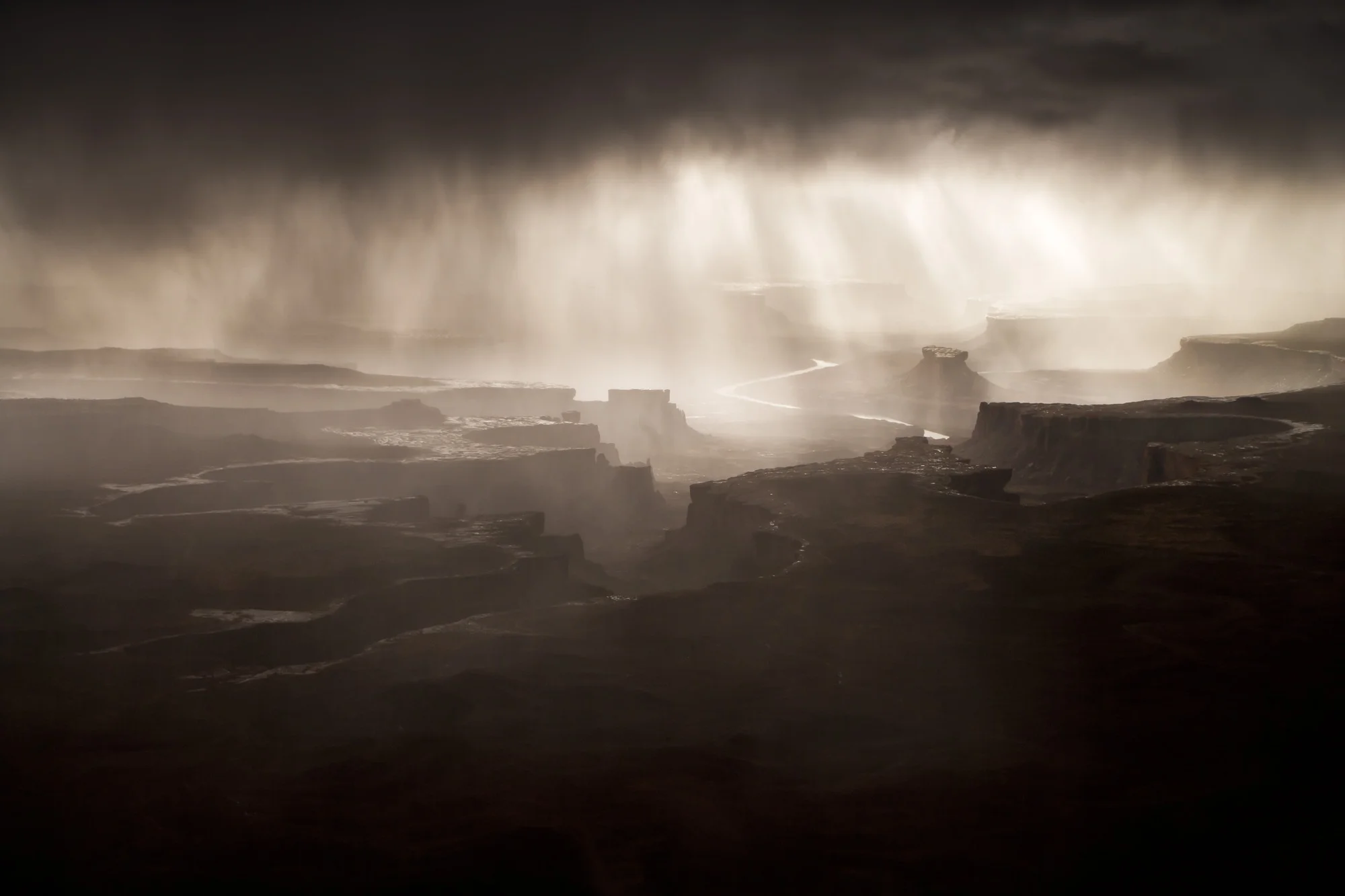
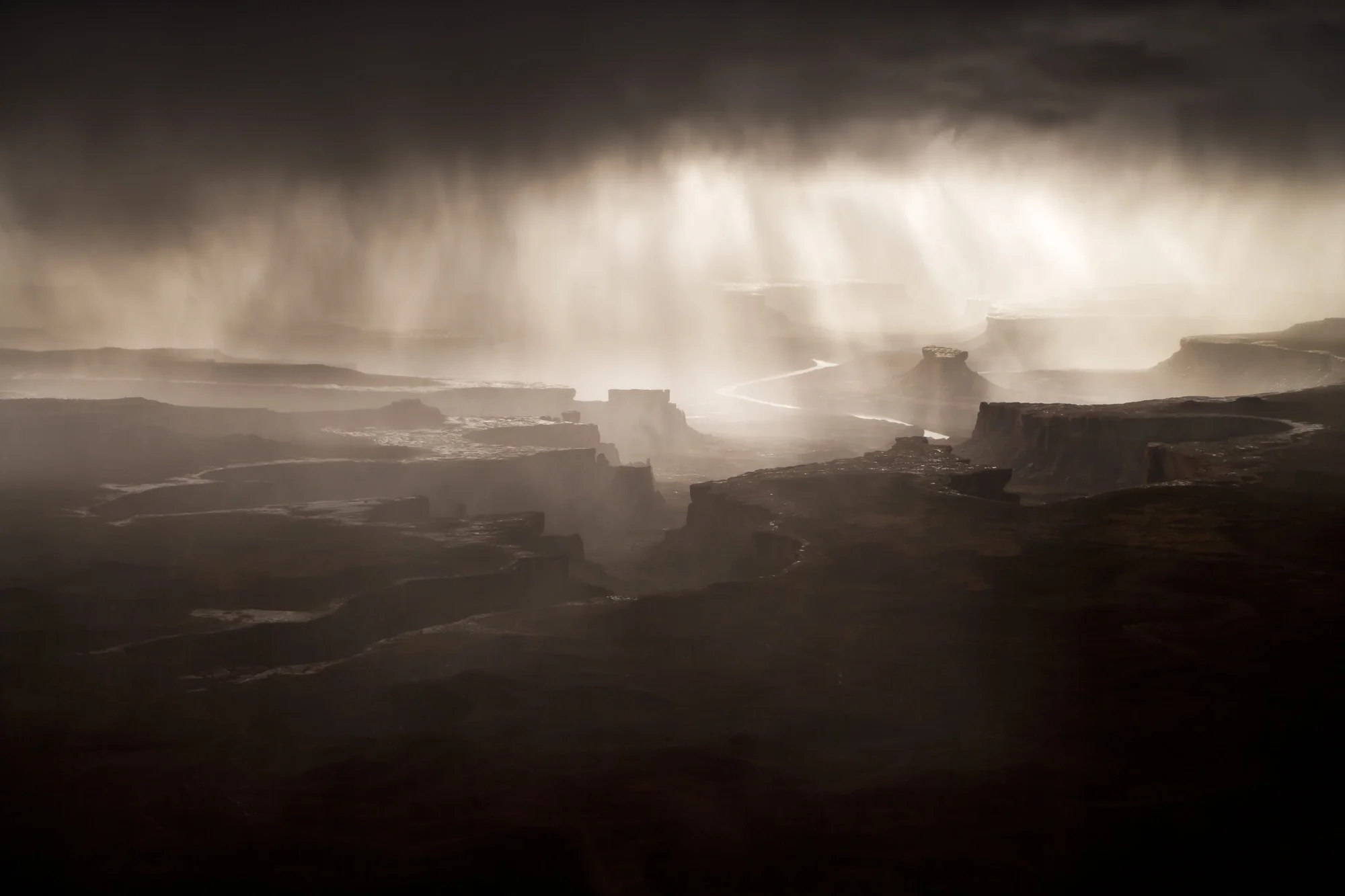
Approaching Storm at Green River Overlook, Canyonlands National Park, Utah
UPDATE 1/16/19 @ 10:58 AM: The clouds are parting and the sun is shining. I predict an amazing sunset tonight, which means the La Sal Mountains, once again freshly dusted with snow, will likely glow pink with alpenglow. Arches and Canyonlands are both open and accessible by vehicle.
UPDATE 1/15/19 @ 11:47 AM: It’s snowing! There are some big, fat snowflakes flying but as of now, there is no accumulation in town. Canyonlands and Dead Horse Point are approximately 2,000’ higher in elevation and may see some accumulation.
There’s a storm brewing and it’s got Moab in its sights. The weather forecast is calling for rain and snow storms through Friday afternoon. Whether or not we’ll actually receive the forecasted precipitation remains to be seen but you can count on some dynamic conditions with potentially interesting skies and possibly even some fog. And, there’s still plenty of snow on the ground from the last storm that came through about a week ago.
Arches and Canyonlands National Parks, Dead Horse Point State Park and all of the surrounding BLM and Forest Service landscapes are open for business, Moab’s a ghost town right now and you can get a hotel room on the cheap. It’s an excellent time for photographers to visit. Be sure to check out my recent post, “The Photographer’s Guide to Winter in Moab”, for winter photography tips and a handful of my favorite locations to photograph when the white stuff is on the ground.
I’ll update this post as the weather moves through the area so if you’re thinking about heading to Moab for photography, you’d be wise to keep an eye on this space for the next few days.
Shameless Plug
If you enjoy the content I share here, please consider supporting me by purchasing a copy of my popular photo guides to Arches, Big Bend or Zion National Parks. Click to visit eFotoGuide to learn more.
Arches and Canyonlands National Parks Are Open!
Arches National Park and Canyonlands National Park are open during the federal government shutdown thanks to a generous donation from the Canyonlands Natural History Association. Moab landscape photographer Bret Edge offers a few tips to help you enjoy your winter visit.

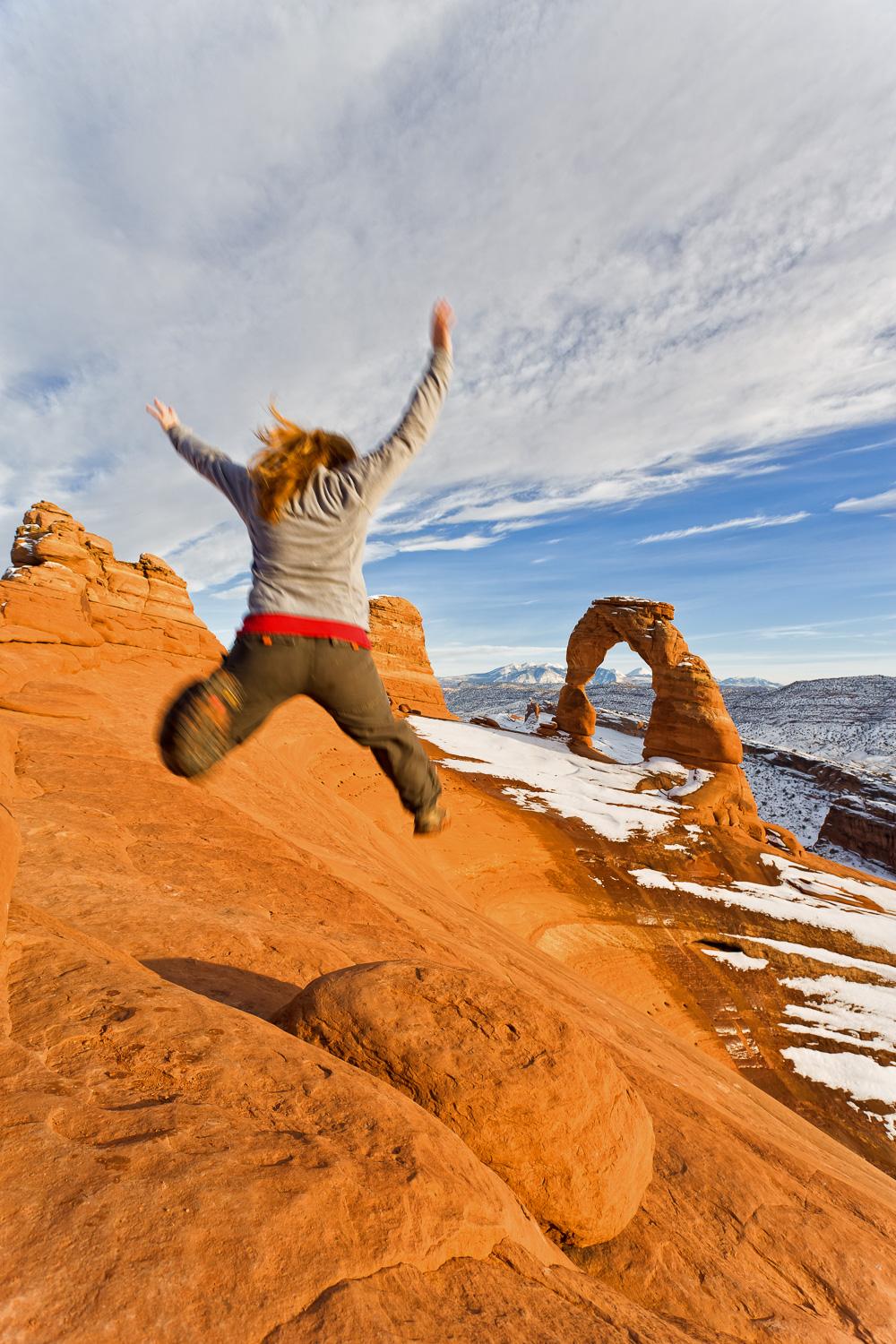
Hiker Leaping at Delicate Arch, Arches National Park, Utah
Need a reason to jump for joy? How about this: As of today, Arches National Park and the Island in the Sky district of Canyonlands National Park are both officially open thanks to a generous donation from the Canyonlands Natural History Association! The visitor centers at both parks will be open daily from 9:00 AM to 4:00 PM and will be staffed by NPS rangers, although they will be operating on a skeleton crew. As an added bonus, it snowed again last night so there’ll be a fresh dusting on those beautiful red rocks!
According to a post on the official Facebook page of Arches National Park, “Efforts are underway at both parks to clear roads and sidewalks. Status of roads may be weather dependent. Park visitors should expect winter conditions throughout both parks. Roads and trails may be covered with snow and ice. Hikers should bring traction devices for snowy and icy trails.
Emergency information may be shared on our Twitter or Facebook accounts, but we will not monitor the accounts or respond to questions. Call 911 for emergencies.”
Arches National Park Facebook Page
Arches National Park Twitter Page
While this is amazing news, both parks will be operating with minimal staff, and it is imperative that you do everything possible to minimize your impact. Please, PLEASE respect the privilege to enter and recreate in these parks. Plan to pack out your own trash and pick up whatever trash you do find lying around. My family and I are headed into Arches this weekend with several empty trash bags and we plan to pick up as much as we can haul. Stay on the trails to minimize resource damage, don’t take pets where they don’t belong and please be safe - you don’t want to the subject of a SAR, especially when park staff is already so thin.
To say “thank you” to CNHA for such a wonderful gift, I will donate to them 30% of the proceeds from all eFotoGuide sales made on Friday, Saturday and Sunday of this weekend. That’s $4.50 for each ebook sold or $12 if you pick up all three in the Ultimate Bundle. I hope you will help me make this a substantial donation.
eFotoGuide: The Ultimate Guide to Photographing Arches National Park
eFotoGuide: The Ultimate Guide to Photographing Big Bend National Park
eFotoGuide: The Ultimate Guide to Photographing Zion National Park
eFotoGuide: The Ultimate Bundle
If you’d rather make a donation directly to CNHA, please visit the donations page on their website.
Canyonlands Natural History Association Donations
If you’re headed into either park with camera in hand, be sure to check out the winter photography guide that I recently published on this blog. Lots of great tips and ideas sure to help you make some fantastic photographs during your visit!
The Photographer’s Guide to Winter in Moab
Thanks for reading, everyone. Now get into the parks and have some fun!
Moab Photography Conditions - January 6, 2019

Fresh Snow at Sand Dune Arch, Arches National Park
Old Man Winter strikes Moab again! Yesterday the weather forecast called for a 30% chance of snow which of course ended up being 3” of snow in town, likely more in the parks. Unfortunately, both Arches and Canyonlands National Parks are closed to all vehicle traffic so bring warm clothing and a desire to posthole or snowshoe for several miles to access any of the winter wonderlands inside either park. No dout, you will be rewarded with solitude and so much beauty it almost hurts. Or maybe that’s your frozen fingers?
Dead Horse Point State Park should be open but call first to verify that the roads are plowed. Other areas in BLM control are open but again, the road maintenance workers have their hands full so it’s hard to say when the lesser traveled roads will be relatively safe to travel. Big thank you to all the men & women running plows today!
Forecast for the rest of the week is looking pretty darn spiffy. Mostly sunny or partly cloudy with high temperatures in the 30’s. This snow isn’t going anywhere for a few days and I suspect even next weekend will provide opportunities for winter photography.
Headed this way to take advantage of the snowy conditions? Be sure to check out The Photographers’s Guide to Winter in Moab on my blog. Totally free resource with lots of great information on how, when and where to shoot wintery scenes around Moab.
Moab Photography Conditions - February 1, 2016
Fresh Snow at Sand Dune Arch, Arches National Park
UPDATE February 2: Arches and Canyonlands NP are open. The roads are snowpacked and icy, and the NPS recommends extreme caution. Dead Horse Point State Park is also open with similar conditions. All backcountry roads are closed. Canyonlands and Dead Horse Point received over 6" of snow. Today there are patches of fog but mostly blue sky with a few light clouds. Perfect conditions for photography!
It's dumping, folks. The snow is flying and according to the weather forecast it isn't stopping until tomorrow. The La Sal Mountains are predicted to receive several feet of snow out of this storm. Down here in town we've already received five inches of snow, which means higher elevations like Arches National Park (around 5,000'), Dead Horse Point State Park and Canyonlands National Park - Island in the Sky (both around 6,000') already have even more on the ground.
As of right now the roads in Arches and Canyonlands are closed. I haven't received any information from Dead Horse Point but I suspect their roads are also closed. National Park Service crews usually clear Arches first, then Canyonlands. Dead Horse Point is usually plowed by state crews before Canyonlands, but that can vary. There is no official estimate of when the parks will open but I suspect it will be later today, or possibly tomorrow, depending on when it stops snowing.
The La Sal Mountains have been getting hammered since yesterday afternoon. Roads into the mountains are not plowed and likely won't be for a few days. However, snowshoes or skis are a viable transportation option if you don't mind putting in a few miles. Avalanche conditions exist and are a very real threat. Travel safe.
One thing is certain: you want to be in the parks as soon as the gates open. All this fresh, untracked snow will make for some absolutely incredible photography conditions. Grand landscapes will be an easy target but don't forget to look for intimate scenes such as juniper trees wearing a robe of snow. Call in sick to work, throw your photography gear in your truck and make tracks to Moab!
Need some help deciding when, where and what to photograph in Arches NP? Pick up a copy of my ebook - eFotoGuide: The Ultimate Guide to Photographing Arches National Park - and you'll hit the ground running with all of the most important information you'll need to make stunning images in this snowy Red Rock wonderland.
Click here to purchase eFotoGuide: The Ultimate Guide to Photographing Arches National Park. Your purchases help me keep this site updated with current photography conditions, and we donate a portion of the proceeds to several organizations who support land conservation and the national parks.
Moab Photography Conditions - December 15, 2015
Winter at the Windows, Arches National Park
Winter has finally arrived in Moab! Three to four inches of snow fell overnight in town and reports from Dead Horse Point State Park as well as Canyonlands - Island in the Sky District indicate over 7" on the ground...and it's still snowing lightly at 0900.
The Island in the Sky Scenic Drive is currently closed due to the snow so if you're interested in visiting the park you'll have to hike/snowshoe until the road has been cleared.
I don't have any reports from Arches National Park or Dead Horse Point with regard to the road conditions. In my experience, the snow is cleared from the roads in Arches first and I-Sky second. Dead Horse Point SP is usually on-point when it comes to clearing their roads and I would expect them to be open very soon, if they aren't already.
With high temperatures over the next couple days hovering at around 30 degrees it's likely this snow will be in good condition for photography through at least Thursday. Once it starts to melt off and become patchy it isn't as attractive in photographs. However, the melting snow can create interesting opportunities for waterfalls where there usually are none.
Camera batteries don't last long in the cold so be sure to keep a couple extras in a jacket pocket where your body heat will keep them warm and ready for use. Know that moving in and out of your vehicle with your gear will result in lenses fogging over and in the winter it takes quite a while for them to de-fog. Remember that the light meter in your camera will underexpose because of all the white snow so be sure to dial in a little exposure compensation. I usually start at around +1 stop and make adjustments as needed.
Now, throw on a down coat, some warm gloves and boots and hit the high desert for some exceptional landscape photography!
Moab Photography Conditions - April 28, 2015

Bloomin' Wildflowers and Reflective Potholes
The last time I wrote an update I warned you all about the quickly melting snowcap on the La Sal Mountains. Luckily, we've had a couple great storms come through the area and they left behind a healthy dose of snow on the peaks so they're actually looking better now than they were a month ago. That said, I seriously doubt that snow is going to last more than two to three weeks.
Those storms also dumped quite a bit of rain in the desert, filling area potholes to near maximum capacity. Larger potholes will hold water for several weeks but the smaller, more common ones will be empty within a few days. Get here while the gettin's good as it's always fun to photograph reflections of arches and towers in these ephemeral little pools.
Lastly, the wildflowers are coming along nicely. This is not going to be a banner year for them but there are enough blooms around that finding a floral foreground won't require too much work. Prince's plume is looking very healthy, as are the claret cup cactus blooms. Mules ear is just starting to bloom and will likely peak in most areas some time in the next 7 to 10 days. I've seen a few Whipple's fish hook cactus starting to flower, some nice clumps of lupine and, surprisingly, there are even a few bright red Indian paintbrush flowers clinging to life at the edges of slickrock and sand dunes.
That's all for now. Oh, one last thing: I've still got one spot available for my Undiscovered Moab Photo Tour next month, May 15-17. Click here to learn more about and/or register for this opportunity to explore and photograph some remote and stunning landscapes around Moab!
Moab Photography Conditions - March 23, 2015
Wildflowers, Waterfalls and National Park Status Updates
UPDATE: March 30, 2015 - Yesterday on a mountain bike ride I saw quite a few wildflowers popping up in the desert north of Moab, even a handful of desert primrose that were looking very healthy. None of the more showy wildflowers are blooming yet, i.e. mules ears. We haven't had any rain or snow (in the La Sals) for well over a week. The snowcap on the La Sals is melting off fast.
Wildflowers and warm weather are here! Okay, so the wildflowers are nowhere near peak but they are starting to pop up here and there. I've seen some really nice bouquets of indian paintbrush at lower elevations as well as a few small white, yellow and purple flowers (sorry, I'm not much of a wildflower recognition expert). Cottonwood trees are just beginning to leaf out and their vibrant green leaves are always a lovely contrast to the rich red sandstone.
Area waterfalls are flowing nicely as the warmer weather melts snow in the La Sal Mountains. Speaking of the La Sals, they still have a snowcap but if they aren't visited by any more winter storms this spring the snow will disappear quickly. Compositions that include the La Sals always look better when they mountains are coated in snow.
Most of the 4x4 roads are open and in good condition, or as good as can be expected of a 4x4 road. As an aside, the National Park Service is considering the implementation of a permit system for day use of Elephant Hill and the White Rim in Canyonlands. For better or worse, you would be wise to keep an eye on the progress of this initiative. Construction on the new, larger parking lot at Delicate Arch in Arches National Park is now underway. Visitors will be impacted. For more information please visit the Arches NP website.
That's all for now. As the wildflower season progresses I'll post frequent updates, hopefully with a few photos, to give you all a better idea of what's happening around Moab in real-time.
Planning a photo trip to Moab? I offer private photography workshops that are designed to get you to the best spots at the best times for incredible photo opportunities. Click here to learn more about a private photography workshop with me.
Moab Photography Conditions - December 26, 2014

Let it snow, let it snow, let it snow! There's fresh snow on the ground in Moab and fog swirling around the cliffs. About an inch fell at 4,000', which means Arches, Canyonlands and Dead Horse Point will all be blanketed in just enough snow to turn the red rock into a winter wonderland. The La Sal Mountains are completely hidden behind a thick layer of clouds and when those clouds finally part, the snow capped peaks will be looking their very best for the cameras.
All main park roads are currently open. Expect some slick, icy spots and drive accordingly. We're already seeing a few patches of blue sky peeking out from behind gray clouds and the landscape is intermittently spotlighted, creating interesting opportunities for photography right now. The storm is predicted to leave the area some time tonight. Sunrise on Saturday morning (Dec. 27, 2014) should be spectacular.
I'm planning to visit Arches this afternoon for a sunset shoot - if the weather and clouds cooperate. If so, I'll update this post with a photo of the current conditions.
Moab Photography Conditions - December 17, 2014

Snow is falling in Moab and it's beginning to accumulate on my lawn, which means higher elevation areas like Arches, Canyonlands and Dead Horse Point will be under a thin blanket of the frozen stuff. The forecast is predicting that it will snow for several more hours today.
The three prime opportunities for winter landscapes will arrive as this storm breaks up, tonight at sunset and tomorrow morning at sunrise. If the storm begins to break apart during daylight hours, the best place to be is in Arches National Park, as rays of sunlight will break through the clouds and spotlight various features in the park. It is highly likely that you'll find arches and spires playing hide and seek in patches of fog. Tonight and tomorrow morning the snow will remain pristine and untrammeled at most locations. If you've ever wanted a photo of Mesa or Delicate Arch under a blanket of snow, now is your chance. Get to Mesa Arch at least one hour before sunrise to ensure that you won't have to compete for tripod space as even in the winter, it is a popular location.
EDIT: At 1055 today the snow in town has turned into rain due to warming temperatures. Arches NP will likely see a mix of rain and snow. At 6,000' in Canyonlands and Dead Horse Point, it will be all snow. The snow level is around 5,000'.
*The photo at top is not from today but is a representation of what you might find tomorrow morning if the Gods of Light are with you. ;-)
Moab Photography Conditions - December 14, 2014
Update on Moab photography conditions on December 14, 2014. Fresh snow and rain has created interesting opportunities for photography in the state and national parks around Moab, including Arches National Park, Canyonlands National Park and Dead Horse Point State Park.
Over the last couple of days the La Sal Mountains just outside of Moab have received significant snowfall down to about the 6,000' foot level. This is my favorite time to photograph local scenes that include the La Sal Mountains, including some of the icons such as Delicate Arch and Balanced Rock in Arches NP, and Mesa Arch in Canyonlands NP. The pristine snow adds another layer of interest in your composition and if you're lucky, the peaks will appear to radiate pink when lit with alpenglow.
Canyonlands and Arches NP, as well as Dead Horse Point State Park, are essentially snow free. However, potholes along canyon rims and in the Courthouse Towers area of Arches NP are filled with water that offers opportunities for reflections of surrounding features. Night temperatures are low enough that many of the potholes will have a thin layer of ice over the top of the water.
As an extra added bonus, hotel rooms are cheap and town is deserted. Don't be surprised if you visit and have Delicate Arch entirely to yourself at sunset! Average night temperatures have been in the low 20's.
Stay tuned for additional updates as weather events create interesting opportunities for photography in the Moab area. Also, check back in the spring for regular updates on wildflower conditions and again in the fall for autumn colors.